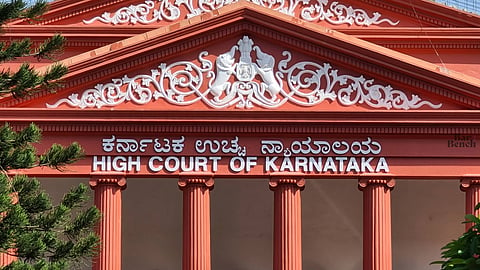
Karnataka HC orders enforcement of SOP to ensure foreigners don't avoid deportation by citing pending criminal cases

The Court ordered the time-bound formation of district and State level screening committees under the SOP introduced by the Central government in 2025.
Karnataka High Court
Published on
4 min read

The Karnataka High Court has issued directives to ensure the implementation of a Standard Operating Procedure (SOP) introduced by the Union government to tackle cases where foreign nationals without a valid visa avoid deportation and overstay in India by citing criminal cases pending against them [Emeka James Iwoba and anr v. State of Karnataka].

Justice M Nagaprasanna has ordered the State to form district and State-level screening committees under the 2025 SOP within four months.

The SOP and the constitution of the Committee is to ensure that valuable judicial resources are not squandered in prosecutions that ultimately serve only to facilitate overstays,” held the Court.

Justice M Nagaprasanna

The direction was issued in an order dated March 5 while quashing the arrest of two Nigerian nationals in a drugs case after finding that the grounds of arrest were not properly furnished.

The Court directed that after their release, the petitioners be handed over to the Foreigners Regional Registration Office (FRRO) (the government authority responsible for regulating the stay of foreign nationals in India) for further action, including deportation.

While deciding the case, the Court examined in detail the SOP issued by the Union government on November 25, 2025.

The SOP provides a framework for withdrawing prosecution in certain criminal cases involving foreign nationals so that they can be deported from India instead of remaining in the country during lengthy criminal trials.

The SOP was framed after law enforcement agencies came across instances where foreign nationals allegedly used ongoing criminal cases to delay deportation and extend their stay in the country.

It is observed that certain foreign nationals have been misusing the legal process of the country by deliberately implicating themselves in criminal proceedings, so as to thwart or delay deportation and thereby prolong their stay within the territory of India,” the Court noted.

The Central government had noted, in its SOP, that foreign nationals adopted a range of tactics during criminal proceedings to delay the criminal proceedings against them and, by extension, their deportation out of India.

These tactics often resulted in long trials or prolonged detention or bail conditions, allowing foreign nationals to remain in India for several years.

The SOP, right from its preambular statement, records a disturbing trend. Foreign nationals once implicated in criminal proceedings were resorting to variety of procedural stratagems such as, repeated adjournments on medical grounds, frequent change of legal representation, filing of frivolous applications, absconding between hearings and raising untenable claims of refugee status,” the Court noted.

To address this issue, the SOP laid down circumstances in which withdrawal of prosecution may be considered, where the government would decide not to continue with a criminal case, subject to approval from the court.

The SOP states that withdrawal of prosecution may be considered in certain cases, including:

  • Where the offences alleged against the foreign national are legally compoundable (offences that can be settled between parties);

  • The offences are punishable with imprisonment of up to seven years;

  • Offences under the Narcotic Drugs and Psychotropic Substances Act carrying punishment up to ten years;

  • Where trial proceedings have been pending for more than five years.

The SOP establishes an institutional mechanism for examining such cases. It requires States and Union Territories to set up district-level screening committees and State-level screening committees to review cases involving foreign nationals and decide whether withdrawal of prosecution should be recommended.

At the district level, the committee is expected to include officials such as the district magistrate, senior police officers and public prosecutors. The committee must examine each case and record a reasoned opinion after considering the legal aspects and broader implications.

If required, cases may then be referred to the State-level screening committee, which includes senior officials from the Home Department, Law Department, police authorities and the Foreigners Regional Registration Office.

The final decision on withdrawing prosecution is taken by the State government or the relevant authority after these committees examine the matter.

Even after the government decides to withdraw prosecution, the step becomes effective only if the trial court grants permission under Section 360 of the Bharatiya Nagarik Suraksha Sanhita, 2023 (law governing criminal procedure in India).

The SOP also lays down the process to be followed after the prosecution is withdrawn.

It says that if the foreign national has a valid passport, authorities are expected to initiate deportation within 15 days of the court’s order.

If travel documents are not available, the authorities must coordinate with the Ministry of External Affairs to verify nationality and obtain the required documents.

Referring to this framework, the Court directed the State government to constitute the required screening committees within four months and inform the Court about the steps taken.

Advocate Ram Prakash Yadav appeared for the arrested petitioners.

Government Advocate Kamal Singh Baghel appeared for the State.

Deputy Solicitor General of India H Shanthi Bhushan appeared for Union of India.

[Read Judgment]

Attachment
PDF
Emeka James Iwoba @ Austin Noso Iwoba v. State of Karnataka
Preview
Bar and Bench - Indian Legal news
www.barandbench.com