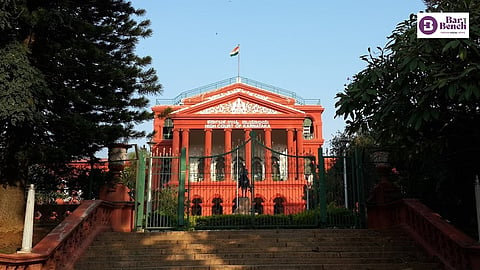

The Karnataka High Court on Tuesday directed the Karnataka Employers’ Association to implead the Union Government as a party in its challenge to the State government's notification revising minimum wages across various scheduled employments [Karnataka Employers Association & Anr Vs State Of Karnataka].
A bench of Justice Jyoti Mulimani issued the direction while briefly hearing petitions challenging the May 22, 2026 notification that revised minimum wages for 84 scheduled employments in the State.
During the hearing, the Court observed that the petitioners were relying on provisions of the new Central labour legislation and, therefore, the Union government's stand was necessary before any interim relief could be considered.
“You (petitioner) are taking shelter under the new Act of the Central Government. If that is the case, the Central Government has to come into the picture. Make the Central government a party. Let us see what the Centre says. Let the Centre say whether it has taken responsibility and removed the concept of scheduled employment and fixed floor wages as uniform wages, or whether it is left to the domain of the State government. After hearing both the Centre and the State government, we will pass orders on the interim prayer,” the Court orally remarked.
After recording the submission of Senior Advocate SS Naganand, appearing for the petitioners, the Court granted permission to implead the Union government and posted the matter for further hearing on June 9.
Naganand argued that the revised wages would have far-reaching consequences across sectors and questioned whether the State could increase minimum wages by 60 per cent or even 100 per cent.
“Sixty per cent wage is increased. Nursing homes and colleges will have to close down. They cannot pay the salary. If you compare with other States, Karnataka is paying the highest salary,” he submitted.
He urged the Court to direct the State not to take any precipitative action pending the challenge, contending that employers would otherwise be compelled to pay revised wages from the next salary cycle.
“It will affect every single worker in the entire State. Hospitals, educational institutions, thousands of industries and millions of workers will have to be paid the new wage now if there is no interim order,” he submitted.
Referring to the statutory framework, Naganand submitted that Section 3 of the Minimum Wages Act, 1948 corresponds to Section 6 of the new Central labour law. According to him, the new legislation does away with the concept of “scheduled employment” and instead contemplates fixation of a floor wage by the Central government.
“Can a notification issue under a statute which is repealed be the basis of fixation of wages under a new statute, which is a Central statute?” he argued.
Senior Advocate Vikram Huilgol, appearing for the All India Central Council of Trade Unions, opposed the challenge and defended the wage revision.
He pointed out that the last comprehensive revision of minimum wages took place in 2017 and that workers had not received a corresponding revision for nearly 9 years.
“2017 is the last revision of the wages. For nine years minimum wage remained the same. In the meantime, the pandemic came and went. War is going on in other parts of the world. All prices have gone up and we should pay the same wages? That cannot be possible.”
Advocate General K Shashikiran Shetty sought one week's time to file objections on behalf of the State government.
The petitioners contend that the wage revision has resulted in increases exceeding 60 per cent in certain sectors, imposing a substantial financial burden on employers.
According to the petition, 34 of the 84 scheduled employments covered by the new notification had already undergone wage revisions during 2022–23. Those revisions are presently under challenge before the High Court in various pending writ petitions filed by employer associations.
The petition contends the State issued a draft notification on April 11, 2025 proposing revised wages for all 84 scheduled employments, followed by a corrigendum on April 19, 2025.
Employer bodies and industry associations objected, arguing that a common wage revision exercise for all employments without considering industry-specific factors was contrary to law.
The employers further contend that several writ petitions challenging the draft notification and wage-fixation process were already pending. During those proceedings, the High Court had passed interim orders in July 2025 directing that any recommendation or decision of the Advisory Board should not be implemented without the Court's permission.
Despite those directions, the State proceeded to issue the final notification on May 22, 2026 without obtaining leave of the Court, the plea states.
It also questions the methodology adopted for wage fixation and argues that the exercise does not comply with statutory requirements under the Minimum Wages Act and principles laid down by the Supreme Court governing fixation of minimum wages.