

The Supreme Court said on Tuesday that questions of paramount importance are involved in the case concerning the validity of Fact-Check Units (FCUs) mooted to identify false or fake news against the government on social media and online platforms [Union of India vs. Kunal Kamra].
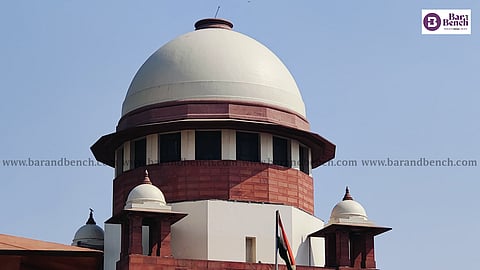
A Bench of Chief Justice of India (CJI) Surya Kant and Justice Joymalya Bagchi said that some of the online platforms act in a dangerous way which can be very damaging, and clear guidelines are required.
Hence, it would be better if the Supreme Court lays down the law in this regard, CJI Kant said while posting the matter to be decided by a three-judge Bench,.
"Question is of paramount importance and it is better the Supreme Court lays down the law. It is about balancing without compromising the constitutional values," CJI Kant remarked.
The Court was hearing the appeal filed by the Central government challenging the Bombay High Court's September 2024 verdict which had struck down the Information Technology (Intermediary Guidelines and Digital Media Ethics Code) Amendment Rules, 2023, specifically Rule 3, which empowers the Central government to form FCUs for identifying false or fake news against the government on social media and online platforms.
"There is no intent to suppress any humour, satire, or critique," Solicitor General Tushar Mehta said on behalf of the Central government
"It is about fact check units and proper rules need to be framed. Blocking rules are there.. section 69 is there," Senior Advocate Arvind Datar said on behalf of stand up comic Kunal Kamra who had challenged the validity of FCU's before the High Court.
The CJI flagged the conduct of certain online platforms.
"The way some of these platforms are acting. See some of the laid out examples.. how dangerous are these. I am not on individual but such news can damage reputation of the institution as well. Clear demarcated guidelines is needed but without putting any onus on those who spread it all needs to be seen. Not an issue with print media much. Look at the army, policies etc," he remarked.
"The rule is effectively struck down now," said Senior Advocate Navroz Seervai on behalf of the original petitioners.
"If the HC would have said rule shall remain inoperational then it was okay, it was different. But when you strike it down, you say rule is not there," the CJI said.
The Bench then issued notice on the government's appeal and directed the respondents (Kunal Kamra and others) to file their responses within four weeks
"Issue notice. Let reply be filed within 4 weeks and rejoinder thereafter. Post the matter before a three judges bench," the Bench directed.
The government sought a stay on the High Court verdict but the Court did not grant the same. Instead, it said that it will hear and decide the matter on priority.
"Let us hear and decide the matter first and at the earliest," CJI Kant remarked.
The IT Amendment Rules, 2023 amended the Information Technology (Intermediary Guidelines and Digital Media Ethics Code) Rules, 2021 (IT Rules 2021).
The same came to be challenged before the Bombay High Court.
The petitions, including one filed by stand-up comedian Kunal Kamra, specifically challenged Rule 3, which grants the Centre the authority to form FCUs for identifying false online news.
The petitioners argued that the amendments were ultra vires Section 79 of the Information Technology Act and violated Article 14 (right to equality) and Article 19(1)(a)(g) (freedom to practise any profession, or to carry on any occupation, trade or business) of the Constitution.
On January 31, Justices GS Patel and Neela Gokhale of High Court delivered a split verdict on the matter.
Justice Patel ruled in favour of the petitioners and struck down Rule 3, citing concerns about the potential for censorship of user content and the shifting of responsibility for content accuracy from creators to intermediaries. He emphasised the need for clear guidelines and criticised the imbalance in addressing grievances related to government information versus other sensitive issues.
Justice Patel highlighted issues related to Article 14, asserting that there was no justification for granting "high value" speech recognition to information concerning the central government over other entities.
In contrast, Justice Gokhale upheld the validity of the amended rules, arguing that they target misinformation with malicious intent while protecting freedom of speech. She stated that a rule cannot be invalidated based solely on concerns of potential abuse, affirming that petitioners and users can approach the court if any intermediary actions infringe upon their fundamental rights.
Following this, then High Court Chief Justice DK Upadhyay appointed Justice Atul Chandurkar to provide a tie-breaking opinion on the case.
Justice Chandurkar then struck down the Rules in September 2024.
"I am of the opinion that it violates Articles 14 and Article 19 of the Constitution," the single-judge
The Central government then moved the Supreme Court in appeal.
[Read Live Coverage]