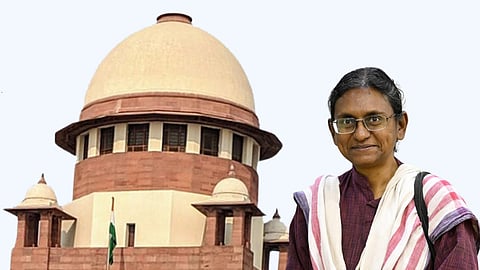
The Supreme Court on Friday dismissed the petition moved by Congress leader Meenakshi Natarajan against the rejection of her nomination papers for the Rajya Sabha elections..A Bench of Justice PK Mishra and Justice AS Chandurkar said the law in election-related disputes was settled that an election petition was not maintainable after the commencement of election process."Whenever an attempt has been made to invoke the jurisdiction of this Court under Article 32, or that of the High Courts under Article 226, during the process of elections, this Court has repeatedly declined interference, having regard to the constitutional mandate contained in Article 329(b) of the Constitution," the Bench said..The Bench refused to accept the argument that where the rejection of a nomination is ex facie illegal, manifestly arbitrary and demonstrably erroneous, the Court ought to intervene."If such a distinction were to be recognised, courts would be required to classify election disputes into two categories—first, those involving allegedly glaring or manifest errors warranting immediate intervention under Articles 32 or 226; and second, those where the aggrieved party must await the remedy of an election petition," the Bench said.The Court added that such a distinction finds no place in Article 329(b) (concerning challenges to elections for legislative posts) of the Constitution."To accept the petitioner's submission would amount to reading into the constitutional scheme an exception which has not been provided by the Constitution itself. We are afraid that any interpretation permitting courts to entertain challenges to rejection of nominations in some cases, while relegating other candidates to the statutory remedy of an election petition, would be inconsistent with the settled constitutional position and ought not to be encouraged," the Bench said, while dismissing the plea..Natarajan's candidature was rejected by returning officer and Madhya Pradesh assembly principal secretary Arvind Sharma on June 9.This was after objections were raised by BJP leaders including Rajya Sabha candidate Mahesh Kewat and party state general secretary Rahul Kothari. The BJP alleged that Natarajan, in her election affidavit, had failed to disclose details of a case pending before a court in Hyderabad..According to the returning officer's order, Natarajan had responded to a notice issued by a Hyderabad court in October 2025 but did not mention the matter in Form 26 submitted with her nomination papers. The returning officer held that the affidavit was incomplete and rejected her candidature on that basis. Congress leaders have maintained that the rejection is legally unsustainable, arguing that no criminal case exists against Natarajan since no court has yet taken cognisance of the private complaint filed against her, and that a pre-cognisance notice does not constitute a pending criminal case requiring mandatory disclosure..Senior Advocate Abhishek Manu Singhvi, representing Natarajan, submitted that the returning officer had acted completely arbitrarily. Singhvi added that in the case pending against her, cognisance may have been taken, but charges have not yet been framed. "The allegations remain to be tested and the matter is still at a preliminary stage. Therefore, there is no violation of the requirements contained in Section 33A of the Representation of the People Act, 1951," Singhvi said.Urging top court to intervene in the matter, Singhvi argued that good governance requires that electoral processes be allowed to function according to law. The Election Commission's role is to facilitate elections and not to frustrate them, he added."Equally, judicial review of an order passed by the Election Commission should facilitate the democratic process rather than impede it. The approach adopted cannot be one that narrows the field of electoral choice. Democracy is founded upon plurality. The law should, therefore, be construed in a manner that preserves plurality rather than restricts it," the senior counsel said.However, the Court referred to the settled law that once a nomination is rejected, only an election petition was maintainable."Is there any judgment of this Court where we have interfered at that stage?" Justice Mishra asked.Singhvi, in response, said,"My Lords, with the greatest respect, that is not the correct formulation for all cases. That is the general rule.".In response, Senior Counsel Mukul Rohatgi and DS Naidu appearing for respondents, submitted that the petition under Article 32 of the Constitution of India was not maintainable as the right to contest an election is purely a statutory right and not a fundamental right."Neither the High Courts in exercise of jurisdiction under Article 226 nor this Court in exercise of jurisdiction under Article 32 can entertain a challenge to the rejection of a nomination during the pendency of the election process," it was argued.They also argued that Natarajan was under an obligation to disclose all pending criminal cases, irrespective of the stage at which such proceedings were pending. It was contended that disclosure is not confined only to those cases where charges have been framed. Solicitor General Tushar Mehta also appeared in the matter on behalf of State of Madhya Pradesh. However, the Court declined to allow the intervention, stating that the State had nothing to do with the election. .Senior Advocate Dama Seshadri Naidu appeared for the Election Commission of India.Senior Advocate Mukul Rohatgi and Advocate Kanu Agrawal appeared for BJP candidates Rajneesh Kumar Agrawal and Mahesh Kewat.