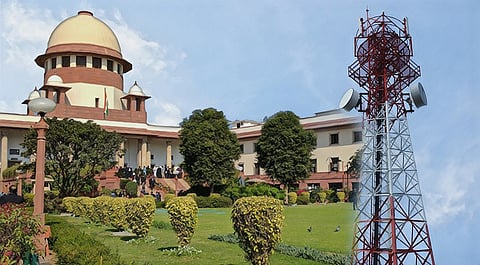
Telecom spectrum not restructurable asset under IBC: Supreme Court in Aircel AGR insolvency dispute

The Court held that material resources must be managed in a manner that subserves the common good and ownership and control of spectrum cannot be determined solely through the lens of corporate restructuring.
Telecom spectrum not restructurable asset under IBC: Supreme Court in Aircel AGR insolvency dispute
Published on
3 min read

The Supreme Court on Friday held that telecom service providers cannot invoke the moratorium under the Insolvency and Bankruptcy Code, 2016 (IBC) to restructure or defer payment of licence and spectrum dues owed to the Department of Telecommunications (DoT) by treating spectrum as a corporate asset [Union of India Vs State Bank of India].

A Bench of Justices PS Narasimha and Alok Aradhe held that material resources must be managed in a manner that subserves the common good.

Accordingly, ownership and control of spectrum, including the economic benefits derived from it, cannot be determined solely through the lens of corporate restructuring.

A copy of the detailed judgment is awaited.

Justice PS Narasimha and Justice Alok Aradhe

The case arose from insolvency proceedings involving Aircel Ltd., Dishnet Wireless Ltd. and Aircel Cellular Ltd.

The companies had entered voluntary corporate insolvency resolution process (CIRP) under Section 10 of the IBC.

They had acquired telecom licences in 2006 under Unified Access Service Licence (UASL) agreements. They had also obtained spectrum through government auctions.

During CIRP, the right to use spectrum was treated as part of the corporate debtor’s assets.

The Union of India challenged this position. It argued that spectrum is a sovereign natural resource held by the government in trust for the people. It cannot be treated as a corporate asset capable of restructuring under the IBC.

The dispute reached the National Company Law Appellate Tribunal (NCLAT), which held that while spectrum is owned by the nation, the right to use spectrum is an intangible asset of the licensee.

The NCLAT held that such rights could be subjected to insolvency proceedings. It also held that licence dues and deferred spectrum payments qualify as operational debt under the IBC. At the same time, it clarified that spectrum cannot be used without payment of dues and that CIRP cannot be triggered to wipe out government liabilities.

The matter then came before the Supreme Court. The Court framed the issue in clear terms. It asked whether telecom service providers, called upon to pay licence dues, could invoke the moratorium under Section 14 of the IBC to restructure their assets. The asset in question was spectrum allocated through auction.

The Court said the issue turns on the legal character of spectrum. It described spectrum as a “material resource of the community.”

It placed the analysis within the constitutional framework governing distribution of material resources to subserve the common good. It held that ownership and control of such resources must remain aligned with public interest.

The Bench structured its judgment in three parts.

First, it examined the legal implications of spectrum under telecom law.

Second, it identified the legal issue - whether insolvency law could be used to alter ownership or control of spectrum.

Third, it examined the treatment of assets under the IBC and its interaction with telecom statutes.

The Court held that the IBC cannot be the guiding framework for restructuring ownership and control of spectrum. Insolvency law, it said, cannot override the statutory regime governing natural resources.

The Bench made it clear that spectrum cannot be treated as a freely transferable asset merely because a company has entered CIRP.

Bar and Bench - Indian Legal news
www.barandbench.com