Thiruparankundram lamp lighting: Appeal filed in Supreme Court against condition mandating ASI clearance

The appeal contends that although the High Court acknowledged the temple’s right to light the Deepam at the Deepathoon, it effectively rendered that right conditional by subjecting it to administrative discretion.
Supreme Court of India
Published on
3 min read

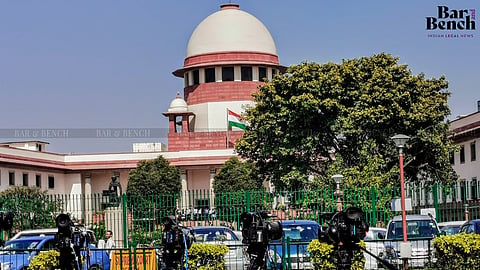
Rama Ravikumar, the original petitioner in the Thiruparankundram case, has moved the Supreme Court challenging a January 6 judgment of the Madras High Court which made the lighting of the Karthigai Deepam at the Thiruparankundram hilltop subject to prior consultation and clearance from the Archaeological Survey of India (ASI) and the police [Rama Ravikumar Vs The Executive Officer, Arulmigu Subramanian Swamy Temple].

In an appeal filed through Advocate G Balaji, Ravikumar has assailed the High Court’s directions as an unlawful dilution of binding civil court decrees recognising the Arulmigu Subramania Swamy Temple’s ownership and control of the hill, and as an impermissible judicial intrusion into an essential religious practice.

The appeal contends that although the High Court acknowledged the temple’s right to light the Deepam at the Deepathoon, it effectively rendered that right conditional by subjecting it to administrative discretion.

On December 1, 2025 a single-judge of the High Court had directed that the Karthigai Deepam be lit at the Deepathoon after holding that the location lay on temple land and outside the demarcated area of the Sikkandar Badusha Dargah.

By its January 6, 2026 judgment, the Division Bench upheld the ritual in principle but imposed regulatory riders.

While the Division Bench did not disturb the recognition of the ritual itself, it imposed regulatory riders. These included directions that:

  • the temple must consult the ASI and the police before lighting the Deepam;

  • the ASI may impose conditions to protect the hill, treated as a protected monument; and

  • the number of devotees permitted to participate may be regulated.

It is these conditions, particularly the requirement of ASI clearance, that form the core of the challenge before the Supreme Court.

Ravikumar’s petition argues that the High Court exceeded its jurisdiction by imposing fresh substantive restrictions despite final civil court decrees affirmed up to the Privy Council, which conclusively recognised the temple’s proprietary rights over the hill.

According to the plea, decisions concerning where and by whom the Deepam is lit fall within the temple’s internal religious management and denominational autonomy, protected under Article 26 of the Constitution, and cannot be made subject to statutory authorities in the absence of a clear legislative mandate.

The petitioner has also argued that the High Court conflated permissible regulation with substantive interference, thereby reducing a constitutionally protected religious practice to a permission-based activity.

The petition traces the dispute to civil litigation dating back to 1920, where the subordinate court at Madurai declared that the entire Thiruparankundram hill vested in the temple except for the specifically demarcated portions such as the Dargah top and the Nellithope burial ground.

Although that decree was reversed by the Madras High Court in 1926, the Privy Council restored the trial court’s findings in 1931. The Council held that the hill belonged to the temple.

That declaration has been consistently recognised by the High Court in subsequent decades, including in disputes relating to quarrying, access and religious observances on the hill, it has been contended.

The petition also relies on a 1996 order of the Madras High Court, which directed that the Devasthanam alone was entitled to light the Karthigai Deepam on the hill, subject to maintaining a minimum distance from the Dargah.

The petitioner has also alleged hostile discrimination, arguing that while devotees of another faith are permitted access and usage rights up to the Nellithope area, Hindu worship at the hilltop has been subjected to layered administrative controls without authority of law.

The appeal comes amid parallel proceedings before the Supreme Court concerning the regulatory control of the Thiruparankundram hill, including a plea seeking a greater role for the ASI at the site.

Bar and Bench - Indian Legal news
www.barandbench.com