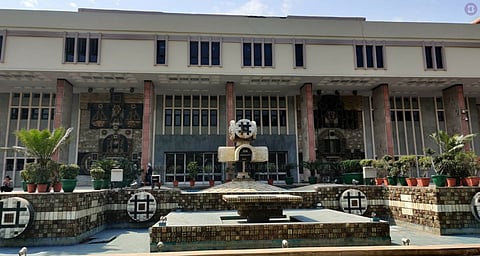
Delhi High Court
Delhi High Court

Unilateral arbitrator appointment can't be cured without express, written waiver: Delhi High Court

The Bench noted that waiver under Section 12(5) is permissible only by an express agreement in writing executed after disputes arise.
Published on

The Delhi High Court recently held that the unilateral appointment of an arbitrator cannot be cured by consent, conduct, participation in proceedings or steps taken before court, unless the parties execute an express agreement in writing waiving the bar under the Arbitration and Conciliation Act. [Omni Projects v. Union of India]

A Bench of Justices Hari Shankar and Om Prakash Shukla dismissed an appeal filed by MV Omni Projects (India) and upheld a single-judge order setting aside an arbitral award passed against the Union of India through the Central Public Works Department (CPWD).

Justice C.Hari Shankar And Justice Om Prakash Shukla

The Court held,

"The rigour of this stipulation is relaxed only in the proviso to Section 12(5). The proviso entitles either party to waive the applicability of Section 12(5) by an express agreement in writing."

The dispute arose from a 2016 construction contract between the contractor and CPWD. After the contract was terminated, the contractor invoked arbitration by issuing a notice under Section 21 seeking appointment of an independent arbitrator.

When CPWD did not appoint an arbitrator, the contractor approached the High Court under Section 11(6) of the Act. The Section 11 petition was disposed of after CPWD stated before the Court that it would appoint an arbitrator in terms of the contract.

Thereafter, an Additional Director General of CPWD appointed a sole arbitrator under the arbitration clause. The arbitration proceeded without protest from either side and culminated in an award dated May 30, 2023, which was adverse to CPWD.

CPWD challenged the award under Section 34 of the Act. The single-judge allowed the challenge and set aside the award solely on the ground that the appointment of the arbitrator was unilateral and contrary to Section 12(5).

Before the Division Bench, the contractor argued that once a Section 11 petition had been filed, CPWD lost its right to appoint an arbitrator. It was contended that the appointment made thereafter should be treated as having court sanction.

The Bench rejected this submission. It held that the High Court had not appointed the arbitrator under Section 11(6) and had merely recorded the CPWD’s statement that it would appoint an arbitrator under the contract.

"The appointment was, even as per the order dated 23 August 2019, in terms of the contract between the parties. As such, this is not a case in which this Court appointed the arbitrator under Section 11(6) of the 1996 Act. The Court only disposed of the Section 11(6) petition on the statement of the respondent that the respondent was appointing the arbitrator in terms of the contract between the parties."

The Court held that the subsequent appointment, therefore, remained unilateral and illegal.

It further held that participation in arbitral proceedings or absence of objection did not amount to waiver. The Bench noted that waiver under Section 12(5) is permissible only by an express agreement in writing executed after disputes arise.

Since no such waiver existed, the Court held that the arbitrator was ineligible to act and that the arbitral proceedings were vitiated from inception.

Omni Projects was represented by Senior Advocate Rajshekhar Rao
with Advocates Subodh Kumar Pathak, Amit Sinha, Abhishek Sandillya,
Pawan Kumar Sharma and Wamic Wasim.

Senior Advocate Rajshekhar Rao

Union of India was represented by Advocates Ankur Mahindro, Ruchir Mishra, Rohan Taneja, Ankush Satija, Aditya Kapur, Mohit Dagar, Raghav Kalra, Animesh Dubey, Creesha Shashtri, Jhanak Setia and Radhika Agrawal.

[Read Judgment]

Attachment
PDF
Omni projects Vs Union of India
Preview
Bar and Bench - Indian Legal news
www.barandbench.com