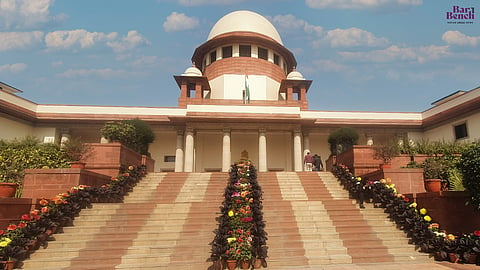
The Supreme Court on Tuesday termed the two-child norm for contesting panchayat elections in Maharashtra as "useless" [Mangala Bhimrao Ingle v. The Additional Commissioner, Amravati Division & Ors].A Bench of Justices PS Narasimha and Alok Aradhe was hearing a plea filed by a former Maharashtra sarpanch, Mangala Bhimrao, challenging her disqualification for having a third child.The Bombay High Court had earlier upheld Ingle's disqualification under the Maharashtra Village Panchayats Act.During the hearing, the counsel for Ingle submitted that she was disqualified from the post of sarpanch after authorities concluded that she had a third child.This prompted Justice Narasimha to question the continued relevance of the two-child norm in light of India's changing demographic profile."What kind of useless policy is this? Javed v. State of Haryana needs reconsideration. The country has changed," the judge remarked.Justice Narasimha then said India's fertility rate has fallen to around 1.7 and that coastal States such as Tamil Nadu and Kerala recorded rates even lower than those of some Scandinavian countries.The judge went on to question the rationale for continuing a policy intended to reduce population growth.Perpetuating such a policy now appeared to be "completely unconstitutional" in the present demographic scenario, the Court underscored."To perpetuate this policy to reduce population in the present situation is completely unconstitutional," said the judge..What kind of useless policy is this? Country has changed.Supreme Court.The case arose from Ingle's election as sarpanch of gram panchayat Kakoda in Maharashtra.A complaint was subsequently filed alleging that she had incurred disqualification under Section 14(1)(j-1) of the Maharashtra Village Panchayats Act, 1959, which bars persons having more than two children from holding the office of a panchayat member or sarpanch.The additional collector at Buldhana disqualified Ingle in October 2024, and the additional commissioner of Amravati division dismissed her appeal. In August 2025, the Bombay High Court upheld both orders, holding that the birth certificate relied upon by the authorities was a public document carrying presumptive value and that Ingle had failed to rebut the evidence establishing the birth of a third child.Ingle then approached the Supreme Court..During the hearing on Tuesday, the Bench observed that it would ordinarily have set aside the High Court judgment, but noted that the tenure of the elected body was almost over.At this point, the Court was told that the top court had already stayed the operation of the High Court judgment in November 2025.The Bench then turned to the larger issue of whether similar two-child disqualification provisions continue to exist in other States. It directed the counsel to ascertain the position."Please find out how many States still have such policies," the Bench said.The Court proceeded to appoint advocate Rukmini Bobde, appearing for the State of Maharashtra, as amicus curiae to assist it on the larger issue.Justice Narasimha observed that while some States continue to enforce such disqualification provisions, others have moved in the opposite direction by introducing incentives to encourage population growth."In your generation or my generation, it is a rarity to have three children. It is only one. This policy has lost its effect. It should immediately be withdrawn. Rival candidates use it as a weapon. We are concerned about this policy," the Court observed.When Bobde submitted that fertility rates had primarily declined in urban areas, the Bench asked her to examine the issue further.The matter was posted for further hearing on July 28.Advocate Pratik R Bombarde appeared for the petitioner, Mangala Bhimrao Ingle..[Read Live Coverage]