Mother's role as primary caregiver can't curtail her right to education: Delhi High Court

The Court made the observation while allowing a woman to move to United States of America (USA) along with her child to pursue a post-graduation course.
Child and Mother, Delhi High Court
Published on
3 min read

The Delhi High Court recently held that a mother's role as the primary caregiver to her child cannot be used to curtail her educational aspirations or personal growth [Twinkle Vinayak v. Vishal Verma]
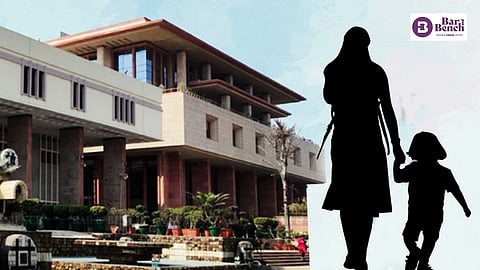
The Court made the observation while allowing a woman to move to United States of America (USA) along with her child to pursue a post-graduation course.

Justice Saurabh Banerjee observed that restricting a mother from pursuing higher education due to her status as a mother would be tantamount to violating her right to personal liberty and development which is guaranteed under Article 21 of the Constitution of India.

"A mother being a ‘mother’ carries equal, if not greater, force where the individual asserting such a right is a mother. Constitutional protection does not diminish on account of the parental status of a party, in fact, it is now settled law that fundamental rights are not to be construed in a manner leading to stereotyping or that which confines an individual to the traditional roles imposed by the society. The fact that a mother is the primary caregiver and responsible for the upbringing of a child cannot be a ground to compel her to surrender her right to education, personal growth, and/ or self-advancement," the Court said.

The Court said that a mother cannot be forced to choose between her child and her career and that the principles of child custody must be interpreted keeping that in mind.

"Every individual, like the mother herein, is entitled to realise his or her full potential, and a mother cannot be compelled to make an invidious choice between her child and her career," the Court added.

It also said that such a balanced approach would not only be beneficial to the mother but also to her child.

"On the contrary, enabling a mother to pursue higher education strengthens her dignity, economic independence, and overall well-being, elements that lie at the core of the Right to Life under Article 21 of the Constitution and, in turn, equips her to provide a more secure, stable, and nurturing environment for the child," the Court explained.

Justice Saurabh Banerjee
The fact that a mother is the primary caregiver and responsible for the upbringing of a child cannot be a ground to compel her to surrender her right to education, personal growth, and/ or self-advancement.
Delhi High Court

The Court made these observations while considering an application moved by the mother of a minor child seeking permission to travel to the USA with the child to pursue a post-graduate degree.

She had been embroiled in a long standing matrimonial dispute with her husband, the father of the child.

A family court had granted the father unsupervised visitation with regard to the child on three Sundays every month and the child's birthday. The mother went to the USA with the child leading to several rounds of litigation before the family court, the Delhi High Court and even the Supreme Court.

The mother ultimately moved the High Court with the present application seeking permission to go to the USA with her child.

She told the Court that she has already completed one semester and that she would secure admission for her child in a school in the USA. She also urged the Court to consider the positive effect the postgraduate degree would have on her employment prospects and, therefore, the quality of life afforded to the child. She also argued that the child has always resided with her and that separating them would be harmful to the child.

The father strongly opposed her plea arguing that the child has a right to receive equal love and care from both parents. He contended that the child's welfare is paramount. He also questioned if the mother would ever come back to India.

The Court at the outset stated that its decision would be aimed at striking a balance between the mother’s fundamental right to personal growth and the best interests of the minor child.

The Court noted that the mother had performed well in her first semester and that the child was young enough to adapt to new environment.

Considering that along with the other facts of the case, the Court deemed it fit to allow the mother's application

Thus, it modified the earlier orders relating to custody and visitation to enable the mother to move to the USA with the child to complete her degree.

The petitioner (mother) was represented by advocate Swati Jindal Garg.

The respondent (father) was represented by advocates Udit Gupta and Nidhi Malhotra.

[Read Judgment]

Attachment
PDF
Twinkle Vinayak v. Vishal Verma
Preview
Bar and Bench - Indian Legal news
www.barandbench.com