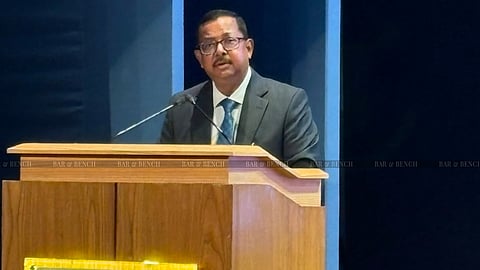
Supreme Court Justice Ujjal Bhuyan on Saturday questioned the celebration of arbitration weeks and international conferences when court verdicts and government policies undermine arbitration.."Erratic court verdicts and regressive policies...act as barriers to India’s efforts to position itself as a global arbitration hub. If this is the approach of the authorities, I ask myself: Is there any need for celebrating arbitration weeks? Is there any need for hosting international conferences on arbitration in India?” he said..Justice Bhuyan was delivering a keynote address on Arbitration in India: The Reform, Relevance and the Road Ahead organised by The Law Forum. Delhi High Court judge Justice C Hari Shankar and former Himachal Pradesh High Court Chief Justice Rajiv Shakdher were also present. Senior Advocate Amit Gupta moderated the event. .The judge criticised the Union Finance Ministry’s June 2024 office memorandum discouraging government departments and public sector undertakings from routinely including arbitration clauses in high-value public procurement contracts.The memorandum suggested restricting arbitration to disputes involving less than ₹10 crore and encouraged government entities to choose mediation or litigation for larger claims.Justice Bhuyan described this as a “short, sudden and controversial policy shift against arbitration”. He pointed out that Oil India Limited and the Oil and Natural Gas Corporation had decided against arbitration in public procurement disputes exceeding ₹10 crore.The Delhi government’s Public Works Department had gone further by removing arbitration clauses from future contracts and subjecting disputes to the exclusive jurisdiction of courts in Delhi. The Union Ministry of Road Transport and Highways had also instructed authorities, including the National Highways Authority of India, not to refer disputes involving ₹10 crore or more to arbitration.Justice Bhuyan said that these measures contradicted the government’s declared objective of promoting India as an international arbitration hub.“In India, most of the State governments and also the Central government are engaging in economic activities with financial assistance from international organisations such as the World Bank, the Asian Development Bank, the International Bank for Reconstruction and Development and the Japan International Cooperation Agency...You are availing funds from these international bodies and engaging in commercial activities. While advancing money to you, they insist that disputes arising out of these funds should be referred to arbitration. And what do you do after getting the money? You say, ‘No, you go to court.’ This is absurd,” he added..The Supreme Court’s 2024 judgment in the Delhi Metro Rail Corporation (DMRC) case caused extensive damage to arbitration in India, Justice Bhuyan said.“One judgment which has caused, I would say, the most extensive damage to arbitration in India is the three-judge Bench decision of the Supreme Court in Delhi Metro Rail Corporation,” he said.The Supreme Court had exercised its curative jurisdiction in April 2024 to set aside an arbitral award more than seven years after it was passed.Justice Bhuyan pointed out that this was done after proceedings under Sections 34 and 37 of the Arbitration and Conciliation Act, 1996, a challenge under Article 136 of the Constitution and a review petition had concluded.“In curative jurisdiction, the Supreme Court undertook a review of the merits of the claims and reappreciated the evidence in what was effectively the fifth round of challenge to the arbitral award,” he said..The judge said the Court had cautioned that curative jurisdiction should not ordinarily be exercised in arbitration matters. However, it ultimately interfered with the award on the grounds of patent illegality and grave miscarriage of justice, he noted.“This judgment is a clear case of judicial intrusion into the domain of arbitration, much beyond what is prescribed by statute."He added that the ruling had raised serious questions about the finality of arbitral awards and India’s suitability as a forum for resolving commercial disputes..Justice Bhuyan also discussed proposals to give courts limited powers to modify arbitral awards. He referred to the Constitution Bench judgment in Gayatri Balasamy v. ISG Novasoft Technologies Limited, which recognised such powers in specified circumstances.“In my view, it has literally opened up a can of worms. It has opened a window for increased judicial interference in arbitral awards,” he said..He referred to Prime Minister Narendra Modi’s 2016 statement that creating a vibrant ecosystem for institutional arbitration was a government priority. The India International Arbitration Centre was subsequently established to provide an independent framework for institutional arbitration, but it had not taken sufficient initiative towards achieving its statutory objectives, Justice Bhuyan said.He also referred to External Affairs Minister S Jaishankar’s May 2024 remarks describing arbitration as an efficient and reputable dispute resolution mechanism that promotes economic growth and the rule of law.Justice Bhuyan questioned how India could discourage arbitration in domestic government contracts while borrowing from international institutions whose loan agreements ordinarily mandate arbitration."The Prime Minister’s vision is something else, the Government of India’s vision is something else and the babus do just the opposite. Then how can India become a global arbitration hub?” he asked.He also rejected the suggestion that mediation should replace arbitration in government disputes.“Mediation is not a competitor to arbitration. Arbitration is not a competitor to mediation. Both can stay together and be used to suit the nature of the dispute,” he said.