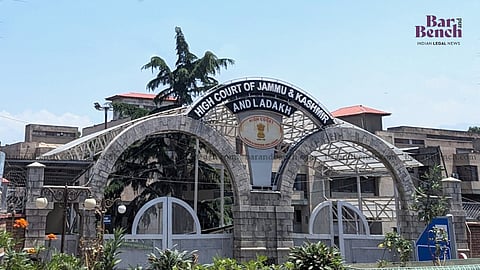

Posters containing material that makes a deliberate attempt to alienate residents of Jammu and Kashmir from the rest of India would be sufficient to attract offences under the Unlawful Activities (Prevention) Act [UAPA], the Jammu and Kashmir High Court recently held [Adnan Bashir Bangroo V/s Union Territory of J&K].
A Division Bench of Justice Rajnesh Oswal and Justice Sanjay Parihar observed that the contents of the recovered posters disclosed "a deliberate attempt" to alienate residents of Jammu & Kashmir from the rest of the country and spread disaffection against the nation.
The Bench also held that the prosecution had placed sufficient material on record to raise a prima facie presumption that the accused were part of a larger conspiracy involving a Pakistan-based handler and members of the banned terrorist outfit TRF, making interference with the order framing charges unwarranted.
"The contents of the posters running across the record are, in our estimation, amply sufficient for charging the appellants with the commission of an offence under Section 13 of the Act. In the text of these posters, a deliberate attempt has been made to alienate the local residents of Jammu and Kashmir from the rest of India, which is sufficient to spread disaffection against the nation," the High Court observed.
The Court further held that while framing charges, a court is only required to examine whether a prima facie case exists and cannot undertake a meticulous appreciation of evidence or conduct a "mini-trial.
The High Court was hearing appeals filed by two accused, Adnan Bashir Bangroo and Mohammad Manan Dar, challenging an order passed by a sessions court in Srinagar on July 12, 2025 framing charges against them under Section 13 (punishment for unlawful activities), Section 18 (punishment for conspiracy, attempt, abetment or facilitation of a terrorist act) and Section 39 (offence relating to support given to a terrorist organisation) of UAPA and Section 506 (criminal intimidation) of Indian Penal Code (IPC).
Dar was additionally charged under Section 40(2) of the UAPA (raising or collecting funds for a terrorist organisation).
The prosecution case arose from a first information report (FIR) registered at Shaheed Gunj police station after a threatening message allegedly issued by the banned outfit The Resistance Front (TRF) through the Telegram channel "Kashmir Fights" targeted polling officials ahead of the 2024 parliamentary elections.
During a vehicle checking on March 19, 2024, police allegedly recovered 39 TRF posters, a bottle of glue and ₹1 lakh in cash from the possession of the two accused, besides subsequently collecting forensic and digital evidence allegedly linking them with a Pakistan-based handler and slain TRF terrorist Momin Gulzar.
The counsel appearing for Adnan Bashir Bangroo restricted his challenge to the charges under Sections 18 and 39 of the UAPA, contending that except for the alleged confessional statement before the executive magistrate, there was no admissible material connecting his client with the alleged offences.
He argued that the disclosure statements could not legally be relied upon since no recovery had been effected pursuant to them.
The counsel for accused Mohammad Manan Dar adopted the same submissions and additionally contended that his client had been falsely implicated. He relied upon an earlier Habeas Corpus petition alleging illegal detention prior to his formal arrest.
The High Court rejected these contentions. It held that the prosecution case extended well beyond the alleged confessional statements. It noted that the investigation had produced technical and forensic material including mobile phone analysis and location data placing both accused at Qamarwari on the relevant date,
The Court also adverted to the WhatsApp communication records, recovery of a photograph of slain TRF terrorist Momin Gulzar from one accused's mobile phone, and alleged communication with virtual numbers linked to a Pakistan-based handler.
The Court held that these materials prima facie corroborated the prosecution case and justified framing charges under Sections 18 and 39 of the UAPA. It also found no error in framing a charge under Section 40(2), observing that the prosecution had produced material showing that Mohammad Manan Dar failed to explain the source of the recovered ₹1 lakh.
The Bench also rejected the argument founded on the earlier Habeas Corpus Petition. It observed that self-serving pleadings could not constitute evidence of "sterling quality" capable of dislodging the prosecution case at the stage of framing charges.
It reiterated that such pleas constitute matters of defence to be examined during trial and not while considering whether charges should be framed.
Hence, the High Court dismissed both appeals.
However, it clarified that all observations made while examining the order framing charges were tentative in nature and should not influence the trial court which should independently appreciating the evidence.
Advocates Shariq Jan Reyaz and Danish Majid Dar appeared for the accused.
Senior Additional Advocate General (AAG) Mohsin Qadiri with advocate Maha Majeed appeared for the Union Territory of J&K.
[Read Judgment]