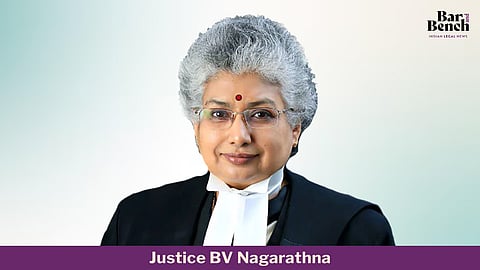
Press can be constrained not by censorship but economic pressures: Supreme Court Justice BV Nagarathna

She cautioned that the gravest threats to press freedom may not arise from overt censorship, but from economic and regulatory pressures that operate more subtly.
Justice BV Nagarathna
Published on
3 min read

Press freedom in India may be legally guaranteed but can be economically constrained in ways that make criticism of the government “costly or unsustainable,” Supreme Court Justice BV Nagarathna recently said.
She cautioned that the gravest threats to press freedom may not arise from overt censorship, but from economic and regulatory pressures that operate more subtly.

The most serious threats to press freedom are likely to arise not from direct censorship under Article 19(2), but from regulations justified under Article 19(6). Ownership rules, licensing laws, advertising policies, taxation and increasingly antitrust law may all be defended as economic regulation, even when they have profound effects on editorial independence,” the judge warned.

The judge added that such measures allow the State to influence the press indirectly while maintaining formal compliance with constitutional guarantees.

Freedom may exist in law, but may be weakened in practice,” she remarked.

The Supreme Court judge was delivering the keynote address at the IPI India Award for Excellence in Journalism 2025 at the Constitution Club in Delhi on February 26.

She further noted that media outlets may remain editorially independent on paper, yet their capacity to pursue adversarial journalism could be limited by the economic or political interests of their owners.

A press outlet may be legally free to criticise the government, yet economically constrained in ways that make such criticism costly or unsustainable. Editors internalise the risk that critical coverage may lead to, for example, the withdrawal of lucrative advertising contracts especially in present times when Governments, PSUs, political parties are vying with each other in being brazen with visual publicity through the press,” she said.

A press outlet may be legally free to criticise the government, yet economically constrained in ways that make such criticism costly or unsustainable.
Justice BV Nagarathna

The award this year was conferred on Scroll journalist Vaishnavi Rathore for her ground report on the Great Nicobar Island Development Project.

Justice Nagarathna went on to underline that the law may not directly silence the press, but it can shape the conditions under which speech is created.

The law may not silence the press; but it may shape the conditions under which speech is created. Certain narratives become safer, others riskier, long before publication decisions are consciously debated in editorial boards,” she pointed out.

On the constitutional position of press freedom, the judge explained that in India, the right emerges from the interaction between Article 19(1)(a), which guarantees freedom of speech and expression, and Article 19(1)(g), which protects the right to practise any profession or carry on any occupation, trade or business.

Press freedom in India is simultaneously protected from two different constitutional angles,” she clarified.

Justice Nagarathna also emphasised the ethical dimensions of press freedom.

Freedom of the press is not only a constitutional right, it is also an ethical practice,” the Supreme Court judge stressed.

She stated that the moral authority of journalism rests on the twin ideals of objectivity and impartiality, which converge in transparency.

Good journalism doesn’t run on goodwill alone. When someone takes a subscription, they’re really saying, this kind of reporting is worth backing.
Justice BV Nagarathna

On the importance of field-based reporting, she observed,

Some stories cannot be told from a distance. They demand ground reporting - from forests and coastlines, from rivers, farms, cities, and communities living with tumultuous change every day. Such reporting performs an essential public function. It connects law with lived reality and policy with consequence.

Justice Nagarathna concluded her address by underscoring that independent journalism can survive only when it is valued and supported by the public.

"Sustained, ground-level reporting does not endure by itself; it survives only when people choose to value it. The civil society must recognise that independent reporting is a public good worth paying for. On the other hand, good journalism doesn’t run on goodwill alone. When someone takes a subscription, they’re really saying, this kind of reporting is worth backing. A press sustained by its readers is always better placed to serve the public interest and fend off political pressures,” she emphasised.

Bar and Bench - Indian Legal news
www.barandbench.com