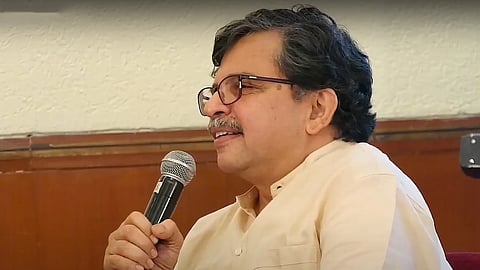
India’s Gen Z has shown that it will not be easily swayed by political rhetoric or propaganda, Senior Advocate and former Orissa High Court Chief Justice S Muralidhar said on Monday..Delivering the DS Borker Memorial Lecture on My Vision of India: 2047 AD at the India International Centre in New Delhi, Justice Muralidhar said the recent protests by the younger generation has offered reassurance that Indian democracy will endure. .Justice Muralidhar observed that Gen Z has remained undeterred despite attempts to portray protesters as “Dimagi Naxals” - a term used by Prime Minister Narendra Modi.“It was reassuring to know that our young generation will not be swayed by rhetoric and propaganda, by powerful oratory reminiscent of the Goebbelsian polemic and empty promises of a Viksit Bharat. They remained undeterred by the demonising of the Dimagi Naxal,” he said..He noted that the July protests demonstrated that the younger generation was prepared to challenge authority rather than accept political messaging uncritically.“It told us that this generation values giving, compassion and adherence to truth. It does not hesitate to ask questions of those in power and, of course, Gen Z has a wonderful sense of humor. The irreverence of the Gen Z is a sure sign of democratic progress...The recent protests by our Gen Z assure us that democracy in India will not be allowed to die and that people will turn to the Constitution and safeguard it in order to preserve this country's future.".It was reassuring to know that our young generation will not be swayed by rhetoric and propaganda. They remained undeterred by the demonising of the 'Dimagi Naxal'. Justice S Muralidhar.Justice Muralidhar's comments on Gen Z came as part of a wider address on his vision for India in 2047. He argued,“Law should not be used to target a group for what they wear and what they eat."He held that India, in the next 20 years, must strive to preserve the space for criticism of those in power.“The India of 2047 would be better served if the law of today does not permit criminalising honest criticism of a government or of those running it, or of their being lampooned in cartoons or joked about by stand-up comedians,” observed Justice Muralidhar.He also criticised the use of criminal law against peaceful protesters. “The India of 2047 would be better served if the government of the day stops weaponising law to punish those who peacefully protest about the denial of basic rights and if it stops labeling them as sinister acts of conspiracy to destabilise the government."He further argued that India’s future constitutional framework should not criminalise personal choices such as marriage and cohabitation. He was specifically referring to what he described as a “spate of uniform civil code legislation” passed in some BJP-ruled States..The growing inequality in wealth and power is a cause for concern and so is the bitter truth that our governments are controlled by corporate oligopolies.Justice S Muralidhar.Justice Muralidhar painted a broader picture he hoped to see in 2047, including a world without the concentration of political power represented by some of today's most prominent leaders.“A day when we find there is no Trump, no Putin, no Xi, no Erdogan and India has a biological Prime Minister,” he said in an apparent dig at Modi's remarks on being "non-biological".He also warned that the concentration of wealth and political influence posed a challenge to India's democratic future.“The growing inequality in wealth and power, both externally and within the country, is a cause for concern and so is the bitter truth that our governments are controlled by corporate oligopolies, here and abroad, to serve their interests.".A day when we find there is no Trump, no Putin, no Xi, no Erdogan and India has a biological Prime Minister...Justice Muralidhar .Justice Muralidhar then turned to the relationship between the State and the courts. He argued that the governments themselves contribute significantly to the litigation burden.“By taking arbitrary decisions, or by not deciding at all, or by unthinkingly criminalising normal activities in a democracy like peaceful protests and unnecessary arrests, government drives the people to the courts."Justice Muralidhar then directed his criticism towards the judiciary itself. He questioned whether courts have consistently fulfilled their constitutional role as a check on State power.“The judiciary's track record in delivering on the constitutional promise of being a bulwark between the people and the anarchic State has at best been inconsistent and quite often disappointing."He warned that the justice system could lose public faith if the courts themselves became oppressive..If court themselves and their processes turn into sites of oppression, it will undermine the faith of the people in the justice system and its ability to deliver fair and equal justice. Justice Muralidhar.On the persistent problem of judicial pendency, Justice Muralidhar cautioned against viewing judges as part of a machine whose output could simply be increased by adding more personnel.“The courts cannot be compared to automobile assembly lines and disposal of cases is not the same thing as assembling cars. It is too simplistic to think that by merely appointing more judges, the existing pendency of cases can be effectively tackled."He also drew attention to the less visible pressures faced by judges, including the emotional toll of dealing with human problems and the relentless demands of their caseloads..He observed that judges also face pressure from unhappy lawyers and litigants, anonymous complaints of corruption, anxiety over disposal rates, intense media scrutiny and strictures from higher courts..Additionally, the former Chief Justice also criticised the internal culture of judicial administration. He said,“The vestiges of both patriarchy and feudalism in the judicial administration is palpable to anyone who has seen its inner workings. There is an obsession with protocols, arcane forms of address, and usage of expressions...This is an anachronism inherited from the colonial past that has survived 79 years. This needs to be acknowledged, interrogated and dismantled.".The ultimate test of judicial reform, he said should be whether it makes the justice system easier and fairer for ordinary litigants to navigate.“Our entire legal system revolves around the convenience of lawyers, judges and the State. It is not litigant-centric. Even today, it is not possible for a litigant to navigate the legal maze without professional legal help. The entire legal system, which includes the judiciary, is only catering to their own convenience,” noted Justice Muralidhar.He commented that the judicial administration had not been as democratic and accountable to its users as it should have been after 79 years of Independence. His assessment came against the backdrop of what he described as a judicial system carrying an enormous caseload. He noted that district courts had more than 5.1 crore pending cases, while High Courts had around 65 lakh and the Supreme Court around 93,000.However, judges alone could not be blamed for the delays and the problem involves multiple actors and structural weaknesses across the legal system, he said.