

Supreme Court Justice BV Nagarathna on Monday made a candid observation on advocates’ income tax returns while hearing a plea filed by an advocate whose appointment as a civil judge was cancelled after a post-selection verification exercise.
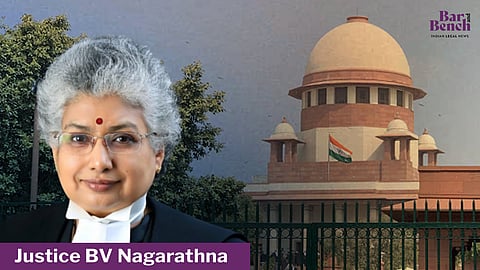
A Bench of Justices Nagarathna and R Mahadevan was hearing a challenge to a Madras High Court judgment that upheld the cancellation of an advocate’s provisional appointment to the Tamil Nadu Judicial Service.
During the hearing, the Bench was taken through the reasons cited for rejecting the advocate’s candidature. One of them related to his professional income as an advocate. That prompted Justice Nagarathna to question whether any advocate truly discloses his or her income while filing income tax returns.
“Please tell me, which advocate discloses the true income in his income tax returns?” she asked, prompting laughter from lawyers in the courtroom.
The judge went on to observe that non-disclosure of criminal antecedents stood on a different footing, but questioned how an advocate’s earnings could become a ground to deny appointment.
“We can understand if he had not disclosed criminal antecedents, but what his earnings were as an advocate, how is it relevant? How can he lose his post?” Justice Nagarathna queried.
The case arose from the cancellation of the advocate’s provisional appointment as a civil judge despite his selection in the Tamil Nadu Judicial Service recruitment conducted for the 2014-15 to 2016-17 vacancies.
The advocate had disclosed in his application that he had previously faced a criminal case in which he was acquitted. After the provisional selection list was published and an appointment order issued, the Madras High Court undertook verification of the character and antecedents of selected candidates.
Following that exercise, the High Court found him unsuitable for appointment, prompting the Tamil Nadu government to cancel his provisional appointment in November 2022.
In February 2024, the Madras High Court dismissed his challenge, holding that provisional selection or even issuance of an appointment order did not create an indefeasible right to appointment.
It ruled that the High Court was entitled to assess a candidate’s character, antecedents and overall suitability for judicial office, and that courts exercising judicial review could not ordinarily interfere with such an assessment unless it was shown to be illegal or mala fide.
This prompted the advocate to move the Supreme Court.
Senior Advocate Guru Krishna Kumar, appearing for the State, said that the issue was not merely the quantum of income disclosed but certain financial transactions that had raised doubts about the advocate’s integrity during the verification process.
The counsel further explained that after candidates are provisionally selected, they are given an opportunity to respond to any adverse material gathered against them before a final decision is taken.
Justice Nagarathna remarked that such complaints were not uncommon once a person’s name was considered for judicial office.
“Yes. Love letters they are called. Against sitting judicial officers. The moment a name is mooted, such kind of complaints arise.” she said.
When counsel informed the Court that the advocate had disclosed his annual professional income as ₹4.5 lakh, Justice Nagarathna continued to question the relevance of examining an advocate’s earnings after he had already cleared the recruitment process.
“Where is the jurisdiction of the High Court to do this after he has already qualified? How many persons have you removed like this? Where is the question of asking explanation of income of an advocate?” she asked.
The discussion then turned to the financial realities of lawyers entering judicial service.
Referring to her own decision to join the Bench, Justice Nagarathna observed,
“₹26,000 was the salary when I joined (as judge). And my income at the bar was much more. But I chose this for service of the nation.”
She also noted that many advocates earn substantially more than judicial officers.
“He will make much more as an advocate than a civil judge. And he has his freedom also. He has not taken charge as such.”
During the hearing, Senior Advocate DS Naidu, appearing for the aggrieved advocate submitted that one judge of the Supreme Court, before being elevated directly from the Bar, had deliberately not recovered nearly ₹10 crore in professional fees from clients to avoid any allegation of impropriety after assuming judicial office.
The Court eventually directed counsel to ascertain whether any proceedings had been initiated against the advocate’s wife, who is a serving judicial officer.
The Court cautioned that no action should be taken merely because the Supreme Court has raised the issue.
The matter will be heard again on August 10.