
Subscribe
Subscribe
- Latest Legal News
- News
- Dealstreet
- Viewpoint
- Columns
- Interviews
- Law School
- Legal Jobs
- हिंदी
- ಕನ್ನಡ
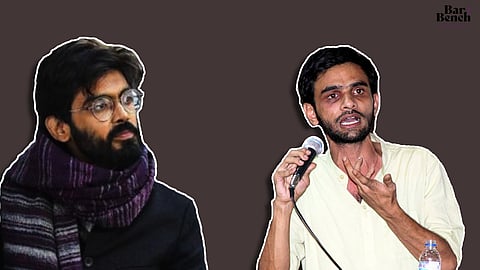
The Supreme Court’s recent order on bail applications arising out of FIR 59/2020, which alleges a “larger conspiracy” behind the 2020 Delhi riots, saw bail being granted to some of the accused, while Umar Khalid and Sharjeel Imam were denied relief under the Unlawful Activities (Prevention) Act, 1967.
These developments bring questions of liberty and pre-trial detention to the forefront.
Chronologically, the prosecution’s narrative travels a long arc. It begins with the JNU controversy of 2016, where slogans raised by unidentified individuals were retrospectively linked to a wider ecosystem of dissent. It then moves through the Citizenship Amendment Act protests of 2019-20 and culminates in the communal violence that erupted in North-East Delhi in February 2020. According to the State, speeches, protest mobilisation and political messaging by certain activists created conditions that ultimately tipped into violence. On this basis, several individuals were arrested under the UAPA, not for direct participation in the riots, but on allegations of conspiracy.
Bail decisions at the trial court and High Court stages reflected a clear divergence. In some cases, courts found the material too vague, inferential or thin to establish even a prima facie case of terrorist activity and granted bail. In others, including that of Umar Khalid, bail was refused on the reasoning that the allegations, if taken at face value, disclosed a deeper conspiratorial role.
The Supreme Court, in the instant case, has relied heavily on Section 43D(5) of the UAPA and its earlier ruling in NIA v. Zahoor Ahmad Shah Watali. It reiterated that courts should not undertake a detailed evaluation of evidence at the bail stage and that the statutory embargo continues to apply so long as the accusations appear prima facie true. Prolonged incarceration, the Court held, does not by itself override this restriction; delay merely triggers a heightened level of scrutiny, not automatic release.
Doctrinally, this approach is consistent with the Court’s recent UAPA jurisprudence. Constitutionally, however, it presents an uneasy paradox. Article 21 has long animated the principle that bail is the rule and jail the exception, a position reiterated across decades from State of Rajasthan v. Balchand to Sanjay Chandra v. CBI. In Arnab Manoranjan Goswami v. State of Maharashtra (2020), the Court reminded constitutional courts of their role as sentinels of liberty when State power is exercised coercively. Even in UAPA cases, the Court in Union of India v. KA Najeeb acknowledged that indefinite pre-trial detention can cross the threshold of constitutional impermissibility.
The difficulty lies not in appreciating the seriousness of the allegations, but in accepting a judicial posture where seriousness alone sustains incarceration for years without a trial in sight. When delay becomes structurally normalised and evidentiary scrutiny is perpetually postponed to the trial stage, the fight for bail begins to resemble punishment rather than protection.
At the same time, an intellectually honest critique must confront the conduct attributed to the accused. Umar Khalid and Sharjeel Imam are not blank slates. Public speeches attributed to Imam - including references to disrupting India’s access to the North-East (often described colloquially as the “chicken’s neck”) and Khalid’s association with polarising slogans such as “Bharat Tere Tukde Honge” - form part of the prosecution’s narrative. Such rhetoric, even where it attracts constitutional protection, inevitably complicates bail adjudication when viewed through the lens of conspiracy and mobilisation.
Yet, constitutional criminal law draws a vital distinction between controversial speech and proven criminal design. At the bail stage, the question is not whether speech is disturbing or irresponsible, but whether it justifies prolonged incarceration without adjudication. The Supreme Court itself has repeatedly held that dissent, ideological opposition and even radical expression cannot be equated with terrorism in the absence of clear, proximate links to violence.
The Court’s own reasoning in granting bail to other co-accused exposes this tension. Parity, role differentiation and completion of investigation weighed in favour of some, while the continued custody of Khalid and Imam rests largely on the perceived centrality of their roles - an assessment that remains contested and untested at trial.
The concern, however, extends well beyond individual culpability. The judgment reflects a broader institutional inclination towards restraint when cases are framed through the vocabulary of national security. Courts appear increasingly reluctant to interrogate expansive conspiracy narratives at the bail stage, particularly when student activists, critics or dissenters against the ruling establishment are involved. Such selective rigour sits uneasily with Article 14, which demands not only equal laws, but equal judicial temperament.
The judiciary must, therefore, guard against slipping into the role of an ideological arbiter. Courts are not institutions for affirming ideological loyalties or validating any prescribed notion of nationalism. Their legitimacy flows from adherence to procedure, neutrality and constitutional restraint. When judicial reasoning begins to mirror political anxieties rather than legal standards, institutional credibility is at risk.
Attempts have also been made to place the Delhi Riots case within wider narratives of foreign interference and regime destabilisation. While such claims may circulate freely in political discourse, constitutional adjudication cannot rest on conjecture or speculative geopolitics. Courts are duty-bound to insist on legally admissible material, not ambient suspicion. Allowing such narratives to seep into bail jurisprudence further blurs the already fragile boundary between allegation and proof.
Ultimately, the issue is not whether the State may prosecute alleged conspiracies. It unquestionably may. The deeper question is whether the Constitution permits the process itself to become the punishment. Deterrence has its place, but criminal justice in a constitutional democracy is fundamentally reformative, not retributive. An overemphasis on deterrence at the pre-trial stage risks inflicting lasting harm without adjudication, turning preventive custody into punishment, imposed through process rather than proof.
The Supreme Court’s judgment, then, is not a simple contest between liberty and security. It reflects a complex and uneasy balancing exercise; one that recognises accused-specific distinctions while simultaneously normalising prolonged incarceration under stringent statutes. History suggests that the judiciary’s most consequential failures rarely arise from overt authoritarianism, but from cautious silence and incremental retreat.
Syed Aqib Hussain is an Advocate at the Jammu Bench of the High Court of J&K and Ladakh and a Doctoral Scholar at SCALSAR, Symbiosis International (Deemed University), Pune.