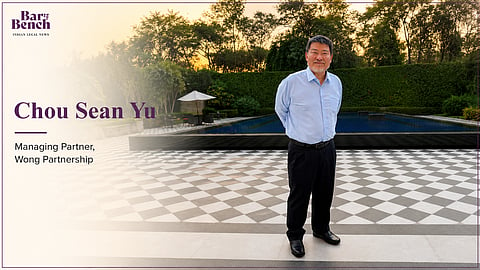

Chou Sean Yu is not a Managing Partner who measures success in just revenue targets or headcount growth. Almost 30 years into his career at WongPartnership, a firm he joined 5 years after its founding and has never left, he instead speaks about leadership transitions, generational custodianship and keeping the founders’ legacy alive.
In this wide-ranging conversation with Bar & Bench's Pallavi Saluja, Sean Yu speaks about his role as Managing Partner of the firm, Singapore's dominance as an arbitration seat for Indian disputes, the challenge of billing in an AI-disrupted world and more.
Edited excerpts follow.
Pallavi Saluja (PS): WongPartnership's founding team reads like a roll call of Singapore's most distinguished legal and public figures - from a Chief Justice to leaders of major institutions. How much does that founding DNA still shape the firm today?
Chou Sean Yu (CSY): We are a relatively young firm by Singapore standards - 34 years old this year. Of the Big Four law firms, we are the youngest. Our founder is still with us as a consultant and still comes into the office. That DNA is very much alive through him.
I was fortunate to join the firm about 5 years after its founding and worked very closely with several of the founding partners. My generation of partners essentially had that same DNA infused into us over time and we have been able to keep that legacy going. Mindset-wise and strategy-wise, things have had to evolve in response to circumstances. In the 1990s, when the firm was founded, things were very different from where we are today but the core values remain deeply embedded in many of us.
PS: Having seen the firm across multiple leadership eras, what has changed the most and what has remained constant?
CSY: When the firm was set up, it had 12 lawyers. When I joined 5 years after its founding, there were 60. One thing that is obviously different is scale - a 60-lawyer firm is very different from what we are today, with 360 lawyers. We also started as a litigation boutique and soon evolved into a full-service firm.
Strategically, that was the one big shift my predecessors had to respond to and build a strategy around. We are the one firm with equal strength in disputes and in corporate transactions. Our competitors have different weightings. That balance has actually worked out very well for us.
When I joined in 1997, it was still predominantly disputes work, rather than the full-service firm we are today.
PS: Now as Managing Partner, how do you see the firm’s strengths and vulnerabilities that you didn't see as an associate or senior lawyer?
CSY: Technology and artificial intelligence - these were things no one would have thought would become significant factors affecting a law firm. I remember when I first started, we were still using fax machines, before the internet, before proper email systems. As a young associate 30 years ago, I wouldn't have imagined needing to respond to any of that. Today, it is the single most obvious challenge we face.
The other factor I had to grapple with was managing different personalities. As a young lawyer, you keep your head down, do your work, seek out experience and get involved in as many cases as you can. Interaction with the human dynamics within the firm was something I barely had to think about. As my role evolved, I soon realised how critical and how delicate that dimension is.
Lawyers, as you know, have large egos. Successful lawyers tend to be type-A personalities and they need to be managed with sensitivity. Otherwise, it gives rise to serious issues that serve no one. The key, I think, is trust and respect. These must be earned. We are still a partnership, not a corporate entity. Every partner has a voice at the table and every partner needs to be heard and able to express his or her views.
PS: The joint law venture with Clifford Chance and its eventual breakdown in 2009, followed by some talent departures - what did that teach WongPartnership about international partnerships and how does the firm approach global alliances today?
CSY: Singapore introduced the concept of joint law ventures between local and foreign firms in the early 2000s. The idea was really to facilitate a transfer of expertise from international law firms to Singapore firms. The underlying logic was - if you want to be an international financial centre, you need to be an international legal centre. So Singapore was very intentional about opening up and liberalising its market, but it also wanted international firms to work alongside local lawyers, not simply to come in, so that the transfer of knowledge would make local lawyers better.
I was still a young partner in those days and wasn't involved in management, so I can't speak to certain details first-hand. What I can say is that the relationship wasn't bad. It was really the global financial crisis of 2008 that disrupted things. I understand there was interest on both sides in deepening the collaboration beyond the joint law venture structure, but the moment the financial crisis hit, those plans were shelved and that is how the joint law venture was ultimately terminated.
A few years later, Singapore evolved its framework to introduce what it called qualified foreign law practices - a licence that allows international firms to develop some Singapore law capability, essentially in corporate work. Two areas remain exempt to this day - domestic litigation and real estate. Under this new framework, foreign firms could also establish their own Singapore partners.
After that period, we came to realise that independence wasn't a bad thing. We benefited considerably from referrals from international law firms around the world that didn't have Singapore offices and knew the quality of our partners' work. That referral stream became quite important and independence made it possible. Had we been tied to another international firm, I don't think those referrals would have come so freely. That has worked well for us and since then, we have never really felt the need to be "married" again.
PS: Singapore is one of the few markets where top domestic firms like yours compete directly with Magic Circle and US law firms. How does WongPartnership position itself against firms that can offer global postings and compensation benchmarks on par with London or New York?
CSY: When I took on this role, I said in a local press interview that one of my priorities was retaining our best talent. It is a genuine challenge, because international law firms offer significantly higher remuneration and, as you say, the opportunity to work across global offices.
For litigation lawyers, the value proposition is somewhat easier to articulate. If you want to be a top litigator, you need court time and real advocacy experience. You stand a far better chance of getting that at a local law firm - where you will argue as counsel in court - than at an international firm that doesn't have the same opportunities for Singapore litigation. Aspiring litigators understand this. Some still leave for international firms because the financial rewards are attractive, but those who are truly committed to a litigation career see that local firms give them the platform they need.
It is a little harder on the corporate transactions side. What we try to do there is demonstrate that the quality and complexity of work here is comparable to what they would encounter at an international firm. The one thing we cannot match is financial compensation and I won't pretend otherwise. It is an issue all Singapore firms face. What we try to do is show young lawyers that they have the potential for a long-term home here. I will be completing 30 years at WongPartnership next year and many of my partners have similar longevity. Hopefully, through us, they will see that the same professional journey is possible for them.
PS: How important is India for WongPartnership and is there a long-term strategy specifically for the Indian market?
CSY: India has been very important, certainly from the international arbitration perspective. The volume of India-related cases with Singapore as the seat is very significant. We are involved in counsel and co-counsel work, as well as arbitration-related court challenges that come before the Singapore courts. This year alone, we are already involved in several of the most significant ones being heard.
This has been the pattern for the last 10 years. Even in my own work as an arbitrator, which I do only a few cases each year as my work is primarily as counsel, the cases I sit on tend to be India-related.
We don't get involved in Indian domestic corporate transactions. Our strategy is to stay engaged in India through strong relationships with Indian law firms. I wouldn't say we have one exclusive best friend - all the Indian law firms that have worked with us value the work we bring and we value them. The fact that we are not exclusive to anyone actually works in our favour.
As for opening an office in India, the answer is no. I don't see what value proposition a Singaporean law firm could offer in the Indian market. You already have excellent lawyers and many strong firms here.
PS: Major Indian disputes have had Singapore at their core. Is Singapore now structurally India's arbitration home, or could that shift if India builds a credible arbitration institution?
CSY: Years of hard work in building Singapore as an arbitration hub have paid off. We are not just seeing Indian disputes; we are a seat for many Asian disputes. India simply happens to be one of the larger contributors in terms of volume.
The reality is that if other jurisdictions do all the right things to build credible arbitration seats, some cases may migrate. But the single biggest factor in Singapore's favour is neutrality. Many of these disputes don't involve any Singapore entity - it is typically an international investor alongside a local Indian partner. When parties need a neutral seat, Singapore offers that. That neutrality advantage is very difficult to replicate.
The other strength is our judiciary. We have an independent, corruption-free court system and our judges are well-versed in international arbitration principles. Many of those sitting on the arbitration list are former practitioners who did this work as counsel and they bring specialist knowledge to every case.
As I said, it's not really a question of India reclaiming its place. The Singapore government is also careful never to become complacent. It is an evolving process and we have been fortunate to have a government that is deeply supportive because they understand that the legal sector is central to Singapore's positioning as an international financial centre.
PS: You've worked closely with Indian senior counsel in Singapore courts and have sat as an arbitrator alongside Indian judges and arbitrators. What has that experience been like?
CSY: Very positive. Indian judges and arbitrators are experienced and, I would say, genuinely world-class. The senior counsel I have worked with have all been deeply impressive: learned, strategic and extremely sharp. They match the best of the London silks. Part of that, I think, is because senior advocates in India are in court every day. That daily advocacy keeps them at a very high level.
I have also been struck by the growth of Indian law firms over the years. Looking back 20 years, Indian firms would approach us to lead cases and support us. That evolved into co-counsel arrangements, with us as lead. Now, I think it has reached the point where they don't need a Singapore firm to support them at all. They are confident to lead arbitrations independently, and they have the advocacy capability to do so. They may come to us if they need specific expertise in Singapore law, but that is a narrower ask. This evolution reflects the significant experience that the top Indian law firms have accumulated and it is something I genuinely admire.
PS: Moving on to AI - in a disputes-heavy firm like WongPartnership, you've been recognised for your AI strategy and your partnership with Thomson Reuters. In a practice built on judgment and advocacy, what is AI genuinely changing and what remains fundamentally human?
CSY: We are among the law firms globally that believe you must have a clear, deliberate approach to harnessing AI. Some firms are still in a wait-and-see mode. I think that is risky. The opportunities and the challenges are here now and if you don't act, you risk being left behind.
We started our AI journey around 2017, among the earlier Singapore firms to adopt contract automation and technology-assisted discovery. Today, the questions we are grappling with are harder. Regarding recruitment: do we hire fewer lawyers, or maintain headcount? Honestly, the answer is not yet clear. On process: AI is already transforming quite a lot. Research has improved dramatically. Discovery, which once meant poring over thousands of documents, can now be assisted significantly by AI. Trial preparation, cross-examination strategy - AI is getting there, though it isn't perfect. For corporate work, the transformation is already very real: turning around documents, drafting term sheets, handling amendments - my corporate colleagues find it enormously useful.
So I think it's going to be transformative. The challenge, as I said, is what this means for recruitment. And the other open question is billing.
PS: Do you see AI reducing the need for junior lawyers, or simply reshaping what early career lawyering looks like?
CSY: At a law firm conference in London in 2024, a McKinsey consultant was asked how many fewer lawyers she expected to see in the US legal market in 5 years. Her answer was 30% less. I think that number still holds today and may even be conservative.
That presents a real challenge for Singapore firms because we recruit our trainee lawyers 2 years in advance. In 2026, we are recruiting for the 2028 and 2029 intake - lawyers who won't be called to the Bar until 2029. We are still recruiting at similar numbers for now. At a recent retreat, I asked my partners to forecast their headcount needs over a 5-year window. There was no real projected decline. That is the question every law firm is genuinely grappling with.
Within the firm, we have been deliberate about not giving trainees access to tools like Harvey just yet. Subscriptions are held by senior associates and partners. We felt partners needed to use AI themselves first; if they don't understand it, they can't roll it out meaningfully. Senior associates have been a good starting point: that generation is adaptive and picks up new tools quickly. For junior lawyers, training is still largely traditional for now, though I think that will change.
I've spoken to managing partners across the world and the views vary. Some are very clear and incisive about what they want their practice groups to do. For us, we still train the old-school way, because we believe that if young lawyers don't get into the trenches the traditional way, they may not fully appreciate what lawyering is. For litigators in particular, court advocacy is here to stay, at least for the foreseeable future. Research is already much faster. AI streamlines preparation. But the oral argument itself still has to be prepared the hard way.
The other thing I should mention is that I think law schools are not really keeping up with AI. I don't know what it is like in India, but in Singapore, it's still taught the old-fashioned way. Although I will say that the law schools in Singapore are very cognizant and certainly know that they have to transform how they do things themselves.
I should also mention that very recently, Singapore's Ministry of Law published a guide on AI use by the legal profession. Our firm was among those consulted during its development. Our Law Minister expressed the view that lawyers who use AI well will be the lawyers of the future. I believe he is right. Within our firm, we encourage each practice group to identify AI champions among the associates - people who will push their groups to find better ways of working with these tools.
PS: Are you facing pressure from clients to rethink the traditional hourly billing model?
CSY: We are, though we don't have a settled answer yet. We are already seeing clients come to us having used ChatGPT to produce a memo on a set of regulations, asking us simply to review and correct it. The expectation, of course, is that the fee reflects only the review time - a much smaller number than if we had produced the memo ourselves. The question law firms are beginning to wrestle with is whether, in those situations, there is a case for premium billing. If you want my expertise and judgment to validate something, perhaps the time-cost model no longer captures that value appropriately. I don't think anyone has solved that yet.
At the other end of the spectrum, there are financial institutions with firm policies against external parties using AI on their data. For those clients, it is still entirely traditional legal work and traditional fees. From a disputes perspective, that traditional model is relatively easier to preserve - you are still in court, still preparing witnesses, still arguing cases in the conventional way. For transactional and advisory work, the pressure is more acute.
PS: Any big structural challenges facing leading Asian law firms?
CSY: Speaking for ourselves: Singapore's domestic market is not large in the way India's is. We recognised early on that we needed to be a regional offering. Some of our competitor firms have opened offices across the region in partnership with local firms. What we chose to do, about 10 years ago, was build our own regional network, an alliance of partner firms that collaborate with us on a non-exclusive basis, with no shared P&L arrangements. The purpose is to be able to tell clients with Southeast Asian mandates that we have expertise across the relevant jurisdictions and effectively a one-stop offering. If a client has multi-jurisdiction litigation spanning Indonesia, Singapore and Malaysia, we can project-manage that through our alliance partners.
India is a somewhat distinct and different market. Our focus is primarily Southeast Asia. An MNC investing in Southeast Asia is unlikely to have a mandate that combines Southeast Asia and India. That is how I see the distinction.
PS: If we were having this conversation 5 years from now, what would success look like for WongPartnership under your leadership?
CSY: For me, it isn't a numbers game. I don't measure success by just growth in headcount or revenue. I measure it by seeing the young lawyers in our firm stay, develop and transition into partners.
To borrow an analogy from Singapore's political history: the founding generation of politicians is referred to as 1G, followed by 2G, 3G and now 5G. In WongPartnership terms, I am probably 4G. My investment is in making sure that 5G is well and truly in place by the time I step down and that they carry the same rigour, the same values and the same sense of direction as every generation before them.
We lost our senior partner Alvin Yeo 4 years ago. He passed away from cancer. Alvin was a great mentor to many of us in the firm. He had encouraged all of us to be the best versions of ourselves. Every year since, those of us who knew him well will meet with his wife, his family, his mother and sisters for lunch to remember Alvin. We want to keep those legacies alive.
So, for me, success is ensuring a strong leadership transition and that the values that built this firm remain intact. It goes without saying that you need to stay Tier 1 in your core practice areas and that you want your partners to be recognised for their work. But those are the obvious measures. The one that matters most to me is passing on what we have been entrusted to keep.