

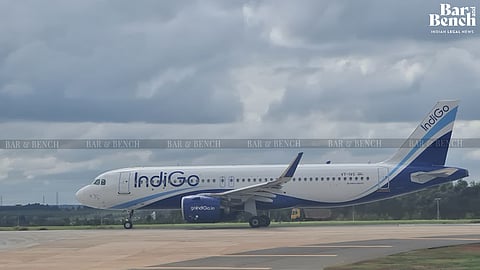
The Delhi High Court on Friday protected InterGlobe Aviation, the owner of IndiGo Airlines, from coercive action in connection with a Goods and Services Tax (GST) demand of around ₹458 crore [Interglobe Aviation Vs Additional Commissioner CGST].
A Division Bench of Justices Nitin Wasudeo Sambre and Ajay Digpaul passed the interim order after observing that, prima facie, the amount received by IndiGo appeared to be 'compensation' and could not be termed as 'supply'.
The case concerns whether compensation received by IndiGo from a foreign aircraft engine supplier for engine malfunction and grounding of aircraft can be treated as a taxable service under GST law.
The airline moved the High Court against a demand of about ₹458 crore and an equivalent penalty. It argued that the tax order was without jurisdiction since the amount received by it was compensation for loss of business and not consideration for any supply of goods or services.
Appearing for IndiGo, advocate V Lakhsmikumaran, told the Court that the airline had imported aircraft along with engines and had paid Integrated GST at the time of import.
However, during 2018-19 and 2019-20, some engines malfunctioned, forcing the airline to ground aircraft for safety reasons.
As a result, a supplementary agreement was entered into between IndiGo and the foreign supplier. Under this arrangement, the supplier issued credit notes worth around ₹2,000 crore to compensate the airline for loss of flying hours and business.
The tax department, however, treated this compensation as consideration for a service allegedly provided by IndiGo. According to the department, by accepting the compensation, IndiGo had agreed to “tolerate” the supplier’s failure to meet performance benchmarks. On this basis, the department demanded GST under the reverse charge mechanism.
IndiGo disputed this finding and relied on Section 7 of the Central Goods and Services Tax Act, which defines “supply”. It also placed reliance on a Central Board of Indirect Taxes and Customs (CBIC) circular dated August 3, 2022.
The airline argued that the circular makes it clear that there must be an express or implied agreement to do something, abstain from doing something, or tolerate an act in return for payment before such payment can be treated as consideration for a taxable supply.
The counsel submitted that mere flow of money from one party to another cannot by itself create a taxable supply. Payments such as liquidated damages for breach of contract are not payments for tolerating a breach, but compensation for loss caused by non-performance, the Court was told.
“The contract is entered for performance, not for breach,” IndiGo argued while relying on the CBIC circular.
The airline also challenged the Commissioner’s reading of the circular. Lakshmikumaran argued that while the circular expressly states that compensation for breach or non-performance is not consideration for any independent activity, the Commissioner had relied on the same circular to reach the opposite conclusion.
He told the Court that the compensation was paid because the engines failed to perform as agreed, resulting in grounded aircraft and loss of business. Therefore, the amount could not be treated as consideration for a service.
IndiGo further submitted that even if the transaction was assumed to be a service, it would qualify as export of service since the other party was located outside India and payment was received in foreign exchange. Therefore, no GST would be payable in any event.
The Delhi High Court issued notice to the tax department and directed counsel appearing for the authorities to waive notice.
IndiGo then sought protection from coercive steps.
When the Court asked how the revenue’s interest could be protected, IndiGo submitted that its solvency was not in doubt. It said it was not a “fly-by-night operator” and that it paid more than ₹20,000 crore annually.
The Court then granted interim protection to the airline.
“In the meantime, there shall be no coercive action,” the Court ordered.
The matter will be heard next after the High Court vacation.