Tractor–trolley unit to be treated as one for fixing accident insurance liability: Delhi High Court

Ruling on a motor accident claim, the Court said liability cannot be split between a tractor and its attached trolley, rejecting the insurer’s defence of policy breach.
Tractor
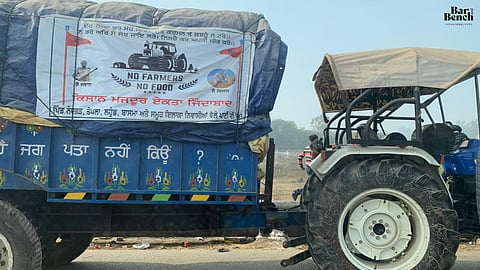
TractorImage for representative purpose
Published on
4 min read
Listen to this article

The Delhi High Court recently clarified that insurance companies cannot avoid paying compensation in road accidents involving tractor-trolleys by arguing that the attached trailer was not separately insured [Reliance General Insurance Co Ltd. v Meena Katiyar & Ors]
In a judgment dated May 29, Justice Anish Dayal held that tractor–trolley unit has to be treated as one for fixing accident liability and the liability of the insurer will depend on what caused the accident.

The case arose from a fatal accident in August 2010 when a 53-year-old man driving from Jaipur to Delhi crashed into a tractor-trolley near Bawal in Haryana. According to the evidence, the tractor, which was moving ahead of the car, had suddenly applied brakes while taking a turn. The car collided with it from behind and the driver later died of his injuries.

His family had approached the Motor Accident Claims Tribunal (MACT), which awarded compensation of over ₹49 lakh. The MACT held that the tractor driver was primarily at fault for braking abruptly. However, it also found that the deceased had contributed to the accident by not maintaining a safe distance. Therefore, it reduced the compensation by 20% on account of contributory negligence.

Reliance General Insurance, which had insured the tractor, challenged this award before the High Court. It argued that the vehicle involved was not just a tractor but a tractor attached to a trolley carrying bricks.

Since the trolley was not separately insured and was allegedly being used for commercial purposes, the insurer claimed that this amounted to a breach of policy conditions. It contended that it should either not be held liable or be allowed to recover the compensation from the vehicle owner.

Justice Dayal rejected this argument, explaining that the trolley could not be treated as an independent factor in the accident.

“The trolley/trailer not being separately insured cannot be held to be the cause of the accident. It so happens that the trolley/trailer is attached to a motorised vehicle which, due to its movement on the road, becomes the cause of an accident. The trolley/trailer has no independent identity as a motorised vehicle on the road unless it is left abandoned or detached from the motorised vehicle and is involved in a situation involving a rear-end collision with another vehicle,” observed the Court.

Justice Anish Dayal
Justice Anish Dayal

The Court noted that the accident was caused by the tractor’s sudden braking and turning, not by the mere presence of the trolley or the goods it carried. On this basis, it held that the insurer could not rely on the trolley to escape liability.

“The principal cause of the accident is the movement of the tractor on the road, involved in ‘abrupt braking’ and ‘sudden turn’. In the opinion of this Court, the carriage of the trolley, together with whatever contents it carried, would not fall within the scope of a successful insurance defence. Accordingly, the plea of the insurance company in this regard is not sustainable,” said the Court.

The Court also addressed a broader pattern in such cases, noting that insurers often try to draw a distinction between the tractor and the trailer. It remarked,

“Insurance companies have often attempted to introduce the distinction between a tractor and trolley/trailer into the controversy.”

The Court held that such technical distinctions should not override the basic question of how the accident occurred.

The Court further explained this approach.

“The driving on the road is by a motor vehicle, namely, the motorised vehicle which is in motion, and the accident is caused due to the alleged braking of that vehicle. Whether a trailer is attached to it or not, and whether it is separately insured or not, would not make any difference, in the opinion of this Court, since the negligence, if any, has to be attributed to the entire tractor-trolley unit being driven by a person and cannot be severed between the tractor and the trailer,” the judgment said.

The insurer had also argued that the tractor’s driver lacked a valid licence because the licensing authority could not trace its records. The Court rejected this, holding that missing records do not by itself prove that a licence is fake.

It noted that the driver had produced a licence that appeared valid and covered the period of the accident.

The Court reiterated that the burden lies on the insurer to prove both that the licence was fake and that the owner failed to take reasonable care. In the absence of such evidence, it held that there was no breach of the insurance policy conditions, and the insurer could not avoid its liability.

Thus, the High Court upheld the MACT's award and directed that the remaining compensation be paid to the deceased’s family.

Advocates Rajeev M Roy along with P Srinivasan represented the Reliance General Insurance (insurer).

Advocates Siddharth Mittal, Sumit K Sharma, Shilpa G Mittal and Abhijeet Varshney appeared for the tractor’s driver-cum-owner.

[Read Judgment]

Bar and Bench - Indian Legal news
www.barandbench.com