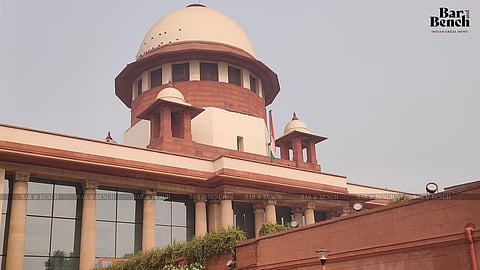
Mere use of abusive words like ‘bastard’ during a heated argument does not amount to offence of obscenity under Section 294 of the Indian Penal Code (IPC), the Supreme Court ruled on Monday [Sivakumar v State rep by Inspector of Police]..A Bench of Justice PS Narasimha and Justice Manoj Misra held that for an offence under Section 294 IPC to be made out, the words must have a sexual or prurient element and mere abuse is not sufficient."In our view, mere use of the word ‘bastard’, by itself, is not sufficient to arouse prurient interest of a person. More so, when such words are commonly used in modern era during heated conversations. We are, therefore, of the view that conviction of the appellants for offence punishable under Section 294(b) IPC is not sustainable and is hereby set aside," the Bench said.The Court thus set aside the conviction of the two accused who had challenged the Madras High Court judgment convicting them under Section 294(b) IPC for using the word “bastard” during an altercation..The case arose from a family property dispute over a common boundary. The altercation began when the deceased attempted to fence the land.Before the Supreme Court, both the accused submitted that no offence under Section 294 IPC was made out.The State argued that the evidence showed that the deceased was abused using the word “bastard” and therefore, the offence under Section 294(b) IPC was attracted.The Court rejected this contention. It held that the word 'bastard' does not have any sexual or prurient element and therefore cannot be termed obscene under Section 294 IPC.“The word “obscene' is not specifically defined in IPC. However, by referring to Section 292 of IPC, it has been construed as something which has the potential to appeal to prurient interest of a person,” the Court added.Drawing from its ruling in Apoorva Arora v. State, the Court reiterated that obscenity involves material that arouses sexual or lustful thoughts and not language that merely causes disgust or shock. Therefore, it held that Section 294(b) IPC was not attracted and set aside the conviction..[Read Judgment in Sivakumar v State rep by Inspector of Police]