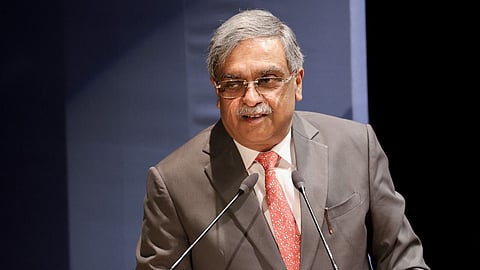
The Supreme Court on Monday witnessed a candid exchange on judicial administration, with Justice Vikram Nath remarking that being the “master of the court” is preferable to being the “master of the roster”. .The term “master of the roster” refers to the Chief Justice of India (CJI), who has the exclusive authority to constitute Benches and allocate cases before the Supreme Court.Pertinently, Justice Nath is next in line to become the Chief Justice of India after the retirement of incumbent CJI Justice Surya Kant on February 9, 2027..The remarks came after a Bench of Justices Vikram Nath and Sandeep Mehta issued notice and stayed an interim order passed by a Division Bench of the Madras High Court which had set aside an earlier single-judge order in a property dispute concerning a residential project in Chennai..Soon after the order was dictated, Senior Advocate Mukul Rohatgi, appearing for the developer, told the Bench that it had not permitted Senior Advocates to appear and argue before it during the summer vacation hearings. “Your Lordships stopped us (Senior Advocates) from appearing during vacations,” Rohatgi remarked.Senior Advocate Abhishek Manu Singhvi, also appearing for the developer, then said that the absence of a uniform practice across benches often create practical difficulties for lawyers.“Lack of uniformity in courts creates problems,” Singhvi said.Justice Nath, however, responded that every judge is entitled to regulate proceedings in the court assigned to them.“No court can ever be uniform in the country. And I am master of my court. Nobody tells me how to run my court! I decide what to do and how to do,” he said..Singhvi responded on a lighter note by observing that Justice Nath would soon be the “master of the roster” as well.“Lordships is soon going to be master of the roster also,” Singhvi said.Justice Nath replied with a smile that he preferred his existing role.“That is a different assignment. This is better. Master of the court is best. Master of roster mein bahaut problem hai (being master of the roster is problematic),” he remarked. .Master of the court is best. Master of roster mein bahaut problem hai.Justice Vikram Nath.The exchange took place during the hearing of a petition filed by Vishveshwara Developers LLP challenging a June 29 interim order of the Madras High Court in a long-running property dispute involving a residential apartment project.The dispute concerns the registration of sale deeds for 99 flats in a residential complex developed by Vishveshwara Developers. Vishveshwara Developers had purchased the property from a previous owner. However, Arulmighu Vadapalani Andavar Kovil Devasthanam claimed that the land belonged to the temple, leading to a civil suit over title.The developer’s vendor succeeded in the title suit, and the decree was upheld by the Madras High Court in 2016. The temple then approached the Supreme Court, which dismissed its appeal in 2018, effectively bringing the title dispute to an end..Following the construction of the apartment complex and the sale of its 99 flats, the sub-registrar refused to register the sale deeds after the temple raised fresh objections, claiming that it had subsequently discovered new documents supporting its ownership claim.Challenging the refusal, the developer moved the Madras High Court. In November 2025, a single-judge of the High Court directed the registration authorities to register the sale deeds, holding that they could not refuse registration on the basis of fresh title claims when the issue had already attained finality before the Supreme Court. Although the sale deeds were eventually registered after contempt of court proceedings were initiated, the temple challenged the single-judge’s decision before a Division Bench.On June 29 this year, the Division Bench passed an interim order in favour of the temple. Aggrieved by that order, the developer approached the Supreme Court..The top court today issued notice and stayed the operation of the Division Bench’s interim order. It, however, clarified that the Madras High Court would be free to hear and decide the pending intra-court appeal on its own merits.