
Subscribe
Subscribe
- Latest Legal News
- News
- Law Firms
- Columns
- Interviews
- Law School
- Legal Jobs
- हिंदी
- ಕನ್ನಡ
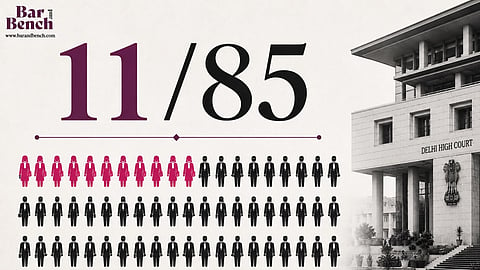
On July 9, 2026, the Delhi High Court designated 85 lawyers as Senior Advocates. Among those are 11 women.
We spoke to the newly designated women seniors about the cases they have handled, the roadblocks they have faced and how they plan to pay it forward to the coming generation of young lawyers, especially women.
Edited excerpts follow.

Abha Malhotra has been practicing law in varied branches of law for 32 years. Her work has ranged from armed forces related matters to original side work, including commercial disputes. At present, she is more focused on arbitration and is empanelled with the DIAC, IIAC, IAC and on the reserve panel of the SIAC.
According to Malhotra, the case of HMM v. Union of India was a most significant one in her career, as it settled an important principle regarding the point in time at which goods become taxable for excise purposes.
Malhotra says that her gender never came in the way of her career progress, a fact that she credits to the character of both the Bar and the Bench of the Delhi High Court. She also credits her family, especially her husband Raaj, for holding down the fort as she works. Her father, AC Gulati, who was himself a lawyer, was her greatest source of inspiration.
"He was in many ways, far ahead of his time. He taught me the value of perseverance, as well as fidelity to the principles one stands for."
That is the legacy she hopes to carry forward for the upcoming generation.
"I hope to carry that legacy forward for the coming generation, especially for women lawyers, not solely through mentorship, but also by continuously improving oneself, one case at a time. That, to me, is the most meaningful way to honour the profession and to contribute to those who will follow."
She also points to Supreme Court Justice BV Nagarathna's emphasis on the idea of sisterhood within the legal profession.
"Just look at the numbers. The Delhi High Court was established in 1966. Till date, fewer than 40 women have been conferred this designation. I am happy to be one of those few, but the number of women, as a percentage of those being designated, needs to improve. Those of us who have been designated, and who are senior in years at the Bar, owe a duty to our younger sisters in the profession to help them persist, and to help them thrive."
Amrit Kaur has been practicing law primarily on the civil side, since 1988. She started out at the chambers of Senior Advocate Gyan Singh Vohra. Since then, she cannot remember taking more than 3 or 4 days off from work, even as she gave birth to her daughter.
"It was tough because my clerk came up to me and said we had to file three writs. For one of the writs, I was their retainer. I just couldn't say no and there was an urgent relief required. The others were also urgent because they were to be filed against the DDA. But I enjoyed doing work, so no regrets. I had a beautiful supporting family which took care of a lot of things back at home," Kaur says.
One of the cases that stands out to her is a matrimonial dispute that involved the father kidnapping the child. She was able to move the Supreme Court and get the mother a divorce and custody of the child. The child is now married and Kaur was invited to attend the wedding.
Kaur credits the senior lawyers whom she worked with for enabling her to build her practice. Even after starting independent practice, she continued to use the chamber of Vohra.
"I was in one of the best chambers where juniors were not called juniors; they were called associates. They were treated like children of the senior. Everybody used to think I'm the granddaughter of Mr Vohra. He gave me the free liberty to use his chamber, which I used for 24 years."
She hopes to carry that forward to the young associates who work with her now. She also advises young lawyers to not tolerate toxic work environments. Young lawyers do not deserve to be demoralised just for being unsuccessful in getting a favourable order, she says.
"There are courts of appeal. We commit mistakes. And we learn every day. You may not get paid a lot in the beginning but then the sky's the limit. Perseverance, professional integrity, and dedication. These are the three things you must follow."
Anju Bhattacharya has been practicing law for over four decades, mostly focused on constitutional law, commercial and civil litigation, cooperative law, property law, tender and contract law, and arbitration. Over the years, she has served as Additional Standing Counsel for the Government of NCT Delhi. Like many others who have been conferred the senior gown this time, she too is empanelled as an arbitrator with the Delhi International Arbitration Centre (DIAC).
"Beyond my professional practice, I have remained deeply committed to pro bono work and legal empowerment initiatives, particularly for women and other vulnerable sections of society," she says.
While she found it difficult to pick out just one case that stands out, her role in Union Public Service Commission v. Nidhi Pandey & Ors, concerning the recruitment of drug inspectors under the Drugs and Cosmetics Rules, 1945, stands out as one of the most significant.
Having had such a long career and being a first generation lawyer also means that she witnessed first-hand how women are at a disadvantage in the profession.
"In India, women account for only 15% of all registered advocates. The main reasons are rigid and long work structures, lack of institutional support and ingrained gender biases. In my case, being a first-generation lawyer, I didn’t inherit connections and clients. I had to start from ground zero and the journey was uphill. I did face challenges like work-life balance, family responsibilities, skepticism from clients and colleagues at some points during my journey."
However, she says that the courtroom was always a haven safe from gender bias.
The law itself has been her greatest source of inspiration in her professional journey. She says that her experience as someone who started out with no networks in Delhi has inspired her to try to make it easier for similarly situated young women lawyers.
"Going forward, I hope to continue supporting the next generation of lawyers, especially women, by sharing my experience, encouraging ethical advocacy, and fostering a culture of excellence, integrity, and mentorship," she said.
Beenashaw Nanda Soni is another first-generation lawyer who has been practicing before the Delhi High Court for over three decades in constitutional, civil, commercial, property, service, labour, matrimonial and arbitration matters. She trained in the chambers of Senior Advocate Vijender Jain (later Chief Justice of the Punjab & Haryana High Court), Senior Advocate SK Mahajan (later judge of the Delhi High Court) and Senior Advocate VK Makhija.
She has served as Senior Standing Counsel for the Delhi High Court and Senior Panel Counsel for the Central government. She is an empanelled mediator with the Delhi High Court Mediation and Conciliation Centre (Samadhan) and an approved arbitrator with DIAC.
"The most important cases, for me, have been those in which I was able to make a difference in someone’s life, or to help a person who was being deprived of their legal rights," she says.
One such case was that of a young school girl who was forced to leave her mainstream school and attend a school for children with intellectual disabilities. Soni was able to secure an order permitting her to continue in her original school.
"Today, she is a bright young woman. It was also my first pro bono case. That case taught me early that a single order of a court can change the course of a life and it formed the basis of my pro bono practice through my career."
She says that the key, especially for women lawyers, is to strike a balance between work and home.
"Like most women of my generation at the Bar, I built my career while also managing my home and raising my two sons and that has required its own discipline."
She credits the Delhi High Court for being "a gender neutral space".
"The women lawyers of earlier generations, who built their practices when there were far fewer of them at the Bar, also showed me what was possible."
Now, Soni sees the senior designation as a responsibility as much as it is a recognition. She intends to keep her chamber open to young lawyers, especially first-generation women lawyers, the way chambers were once opened to her.
"I hope to see more women leading in litigation - as arguing counsel, arbitrators, designated Senior Advocates and judges."
Kanika Agnihotri has been practising law for 23 years, primarily focused on civil and commercial litigation, writs and arbitration. Her father Justice Swatanter Kumar is a retired judge of the Supreme Court of India and former chairperson of the National Green Tribunal. She began her career with Gita Mittal & Associates, which gave her ample opportunities to argue cases early on. She later joined Karanjawala & Co, where she got the opportunity to brief the stalwarts of the profession and engage with top tier clients.
Of all the cases she has handled, one that stands out saw her arguing before the Delhi High Court on the legal question of whether a petition filed under Article 227 of the Constitution of India would be maintainable in a case where a statutory appeal had otherwise been provided.
For her, inspiration can be found everywhere, if only one is open to receiving it. That includes her family and doyens of the profession both on the Bench and the Bar.
"From back when I had just joined the profession to this date, I was, am and shall continue to be inspired by our judges. Seniors counsels who were extremely kind with their words and their encouragement, whether before courts or in front of clients, have constantly pushed me to strive harder and do better. Junior colleagues who raised their hand to help me do the heavy lifting in bulky matters, even when they did not have to, have been constant sources of support. It is the support that I have received from all these quarters that has inspired me to work hard and give my best to every opportunity that has come my way."
Mamta Tiwari, who has been practising law for 29 years, started her career interning with advocate Alok Agarwal and later worked at the chambers of Senior Advocate Parag Tripathi. As a first-generation lawyer, she knew few people in the legal community when she entered the profession.
"The challenge was to find the right chamber and, more importantly, a senior who would be willing to invest time in teaching and mentoring me."
In 1998, she joined Fox Mandal & Co as an Associate and, within a short span, became a partner until 2010, when she left to start her independent practice.
She has appeared before various courts across the country in issues relating to power, securities, oil and gas exploration, commodities trading, foreign exchange laws, maritime and shipping laws, media, entertainment and broadcasting laws, intellectual property issues, etc.
One of the cases that stands out in her professional journey was the India-Mauritius Bilateral Investment Treaty arbitration. Conducted under the aegis of the Permanent Court of Arbitration at The Hague and governed by the UNCITRAL Rules, 1976, it was the first - and at the time, the largest -claim brought against India.
"What made the matter particularly fascinating was its sheer complexity. I got the opportunity to work with stalwarts like Sir Arthur Watts as the matter involved questions of public international law besides constitutional law principles, English law and Indian law."
Besides her parents, especially her late father LB Tiwari who was an IAS officer, she credits the two senior lawyers she worked with, as well as Senior Advocate AK Ganguli, who led her through her first international arbitration and taught her the finer nuances of a trial. All of these legal experts continue to mentor and guide her to this day, she says. She adds that her years as a Partner at Fox Mandal offered her an invaluable platform and exposure to both Indian and international legal practice.
To young women lawyers, she says,
"Do not give up even when the grind seems endless."
Interestingly, Tiwari says she did not face any gender bias and that she is sure that her young colleagues will not suffer it either.
"Integrity is your greatest asset and your work will always speak louder than self-promotion. Let your work do the talking!"
Manali Singhal began her career with the erstwhile Amarchand Mangaldas. She later set up her own independent practice and has been practising for over 30 years primarily in matters dealing with power, telecom, corporate sector, general commercial litigation, PMLA, customs and family law.
She is a founding trustee of the Justice Sunanda Bhandare Foundation, named after her mother, and a trustee of the Guild for Service, which works in the field of gender justice and women's empowerment.
"Whilst many cases have been gratifying, one case which is close to my heart is the Justice Sunanda Bhandare Foundation v. Union of India & Ors. The Foundation works towards the upliftment of women and marginalised sections of society. This case was filed to ensure that the Rights of Persons With Disabilities Act, 2016 is followed in letter and spirit by all states," she says.
Singhal is candid about the fact that she has had to face gender stereotyping at several points in her career. Being a single parent meant that maintaining a work-life balance has been a challenge.
"Although much has changed since then, it is still a long way away before women receive equal recognition for their acumen and competence."
The work of other senior lawyers like Indira Jaising have kept her inspired through this journey.
"My involvement in [the Justice Sunanda Bhandare Foundation and Guild for Service] has helped me to support others to overcome challenges. I aim to continue to support women so that they fulfill their ambitions and get their fair due. Women lawyers need to to stand by and support each other as patriarchy and male dominance are still prevalent in the profession."
Maneesha Dhir has been practicing law for over three decades, mainly focused on corporate and commercial litigation, insolvency laws, arbitration, telecommunications, M&A and corporate advisory. She has been a Senior Panel Counsel for the Central government and is also a member of several arbitral institutions.
The cases that have played a role in shaping the law itself are the ones that stand out to her in her professional journey.
"If I were to identify the most defining work of my career, it would be my involvement in landmark matters across insolvency and restructuring, arbitration, telecommunications and corporate law, involving complex legal and regulatory issues, while also contributing to policy-making through my participation on various expert committees," she explains.
Every stage of her professional journey brought its own unique challenges. But Dhir says that she chooses to view them as experiences that strengthened her, rather than obstacles.
"The law itself has undergone tremendous transformation over the past three decades, whether through legislative reforms, technological advancements, or the increasing complexity of cross-border disputes. The evolution has taught me that experience alone is never enough; remaining relevant requires continuous learning, adaptability and an openness to new ideas."
She finds inspiration in the other of senior members of the Bar, judges and other colleagues who have built their careers with integrity and grit.
"The legal profession becomes stronger when experienced lawyers actively create opportunities for the next generation and I hope to give back by mentoring young lawyers, particularly women, sharing my experiences and helping them build careers founded on integrity, excellence and empathy."
Rajeshwari Hariharan started her legal practice in 1993. In the early years of her career, she practised before district courts, handling civil and criminal matters. She later practised IP law with K&S Partners, where she specialised in patent prosecution, intellectual property strategy and contentious IP work.
She then founded Rajeshwari & Associates and has been handling matters primarily related to intellectual property, commercial disputes and arbitration. It is no surprise then that Hariharan was involved in several landmark intellectual property matters, including India’s first compulsory licence and challenges to exclusive marketing rights
"[These cases] required the courts to interpret provisions that have a continuing effect on innovation, competition and access to medicines," she explains.
For her, the biggest challenge at the beginning of her career was not merely finding work, but being trusted with serious work.
"As a young woman in litigation, there was often no overt exclusion, but there was certainly a lower presumption of competence. One had to establish, repeatedly, that one could understand complex facts, handle difficult clients, cross-examine witnesses and argue substantial matters with the same authority as any male colleague. Confidence was not automatically extended; it had to be earned case by case."
She did not begin with a ready-made practice or an inherited professional network. Running her firm and mentoring young lawyers while continuing to remain an active arguing counsel too has been its own challenge.
"For me, the journey has been less about overcoming one dramatic obstacle and more about repeatedly proving that excellence can be built, sustained and passed on, despite structural bias, professional uncertainty and the changing demands of legal practice."
Hariharan says that she is inspired by other senior lawyers, including Dr. Abhishek Manu Singhvi, Arun Jaitley and Harish Salve.
She worries that the expectation of quick results might hamper the careers of young lawyers.
"For women lawyers, the journey is often even more demanding. At several stages, women are required to work harder simply to establish the same presumption of competence. They must often prove that they can handle difficult clients, complex facts, long hours, travel, pressure and serious courtroom responsibility. My effort has, therefore, been to ensure that younger women in the profession are not merely given routine or supportive work, but are trusted with substantive drafting, strategy, conferences and arguments."
Sangeeta Bharti has been practicing law for 32 years. She was the Founding and Managing Partner of Jurisperitus Law Offices (JPL) till she resigned from the partnership in March 2024 to start her independent practice.
She points to three standout cases in her career - one on the enforcement of a foreign award in India; another on the long-standing dispute on sharing of Ravi-Beas river waters among Punjab, Haryana, Rajasthan and Delhi; and finally the Constitution Bench case regarding the reconsideration of the Bangalore Water Supply case.
Bharti says that while she had to strive hard to be taken seriously as a first-generation lawyer and a woman in the profession, times are changing. Her biggest inspiration has been her mother, who got married at the age of 16 but ensured all her children including Bharti would be well-educated. She also names Senior Advocate and former Cabinet Minister Ashwani Kumar as a source of inspiration and guidance.
To young women lawyers, she asks only that they believe in themselves and conduct themselves with integrity.
"Even if they face obstacles, there is nothing that stops them from coming out stronger. We have excellent judges both in the High Court and the Supreme Court who faced no gender bias. So long as one is ethical, dedicated, methodical and sincere, I see no reason why we will not have equal numbers of men and women in the profession. May our tribe flourish."
Warisha Farasat has been practicing law for close to 20 years and has been involved in criminal, constitutional and civil matters before various forums.
She highlights her involvement in a case dealing with the scope of challenging arbitral awards and in another case dealing with the power to grant remand during investigation, as standout cases in her career.
"The opportunity to argue before a Constitution bench of the Supreme Court in the challenge to Article 370 was also a memorable experience and a milestone in my professional journey," she adds.
Over the course of her career, Farasat has witnessed some encouraging changes in the profession, but admits that women continue to face certain unique challenges.
"Early on, one of the key challenges was establishing credibility in an environment predominantly occupied by men, primarily among clients who tend to trust the legal opinion and ability of male lawyers far more than those of female lawyers. Even though the judges have always been encouraging and appreciative of competence in the Bar irrespective of gender, the system tends to be prejudiced against women when clients are predisposed against female lawyers."
For Farasat, the makers of the Constitution are her greatest sources of inspiration, especially Dr BR Ambedkar and the 15 women members of the Constituent Assembly. On the latter, she says,
"They demonstrated that women were not merely beneficiaries of constitutional rights - they were architects of those rights."
She is equally inspired by Maulana Abul Kalam Azad.
"His idea that an educated citizenry is essential for a strong democracy and for meaningful exercise of constitutional rights resonates deeply. His belief that citizenship transcends divisions of religion, language and culture continues to guide the way I understand justice and the rule of law."
Farasat also draws inspiration from the women lawyers who came before her and opened up the profession for future generations. To young women lawyers, she says,
"I want them to know that their voices matter, that diversity strengthens the legal profession and that excellence and compassion can coexist. Times are the most testing for women lawyers in their 30s, as this period brings its unique challenges for women. It is important for young female lawyers to stay resilient and have faith in your abilities during these testing times. To all young women lawyers, I want you to remember that every step you take with courage and perseverance contributes to a stronger future for women in law."