
Subscribe
Subscribe
- Latest Legal News
- News
- Law Firms
- Columns
- Interviews
- Law School
- Legal Jobs
- हिंदी
- ಕನ್ನಡ
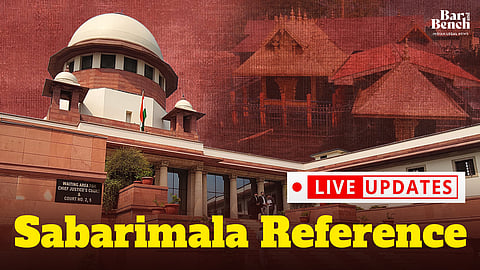
A nine-judge Constitution Bench of the Supreme Court is examining seven important legal questions concerning religious rights and freedoms in India. The top court began hearing the reference arising out of the Sabarimala review case on April 7.
The Court's verdict will have a major impact on various individual cases including whether women can be allowed to enter the Sabarimala temple in Kerala.
The reference is connected to the top court's September 2018 verdict in which a 5-judge Constitution Bench, by a majority of 4:1, allowed women of all ages to enter the hilltop shrine in Kerala. That decision overturned the tradition that restricted the entry of women of menstruating age.
The ruling triggered widespread protests across Kerala and led to dozens of review petitions being filed by various individuals and organisations before the apex court.
In November 2019, the Supreme Court pronounced its judgment on the review petitions challenging the 2018 verdict. It held that larger issues pertaining to the Essential Religious Practices Test, interplay between Articles 25 and 26 on one hand and Article 14 on the other and the conflict between the judgments in the Shirur Mutt case and Durgah Committee case will have to be decided by a larger Bench.
The nine-judge Bench is now considering the same.
A Bench of Chief Justice of India (CJI) Surya Kant along with Justice BV Nagarathna, Justice MM Sundresh, Justice Ahsanuddin Amanullah, Justice Aravind Kumar, Justice Augustine George Masih, Justice Prasanna B Varale, Justice R Mahadevan and Justice Joymalya Bagchi is hearing the matter.
During the hearing on April 7, the Central government advocated for greater freedom in religious practices and asked whether courts are the appropriate forum to determine what constitutes an essential religious practice.
On April 8, the government argued that that the restriction at the Sabarimala temple was not based solely on gender.
On April 15, the Court observed that one of the most difficult tasks for a court is to declare the beliefs of millions of people as wrong or erroneous, and that a religion cannot be stripped of its essential practices in the name of social reform.
On April 17, the Court observed that while adjudicating matters of faith, a constitutional authority must rise above personal religious beliefs and be guided by freedom of conscience and the broader constitutional framework.
During yesterday's hearing, the Court remarked that it is aware of the limits of judicial review in religious matters and that there was no need for extensive arguments against it.
Live updates from the hearing today feature here.
Senior Advocate Gopal Subramanium: All persons are equally entitled to freedom of conscience and the right freely to profess, practice and propagate religion. These words are of significance because they must be understood in an expansive and fundamental manner, especially before we turn to the concept of denomination in Article 26.
Article 25, in my submission, represents the expanse of religious freedom. It deals with multiple facets of that freedom. Before we come to the expressions “profess, practice and propagate”, one must first understand the concept of freedom of religion itself.
Senior Advocate Gopal Subhramiam: It begins with the personal journey of an individual in accepting a philosophy as a religious philosophy. Religion therefore has more components than what is often reflected in judgments. Broadly speaking, it has four aspects, all of which are covered within the freedom of religion under Article 25(1).
The first is the doctrinal or philosophical content of a particular faith. The second is the practices associated with that philosophy. The third is the right of worship. And the fourth is the extent of belief.
These four areas together constitute the full scope of religious freedom.
Senior Advocate Gopal Subramanium: Individuals have the freedom under Article 25. Now, when we come to the word “profess”, it can mean professing in private, and it can also mean professing in public. That is part of religious freedom.
The next word is “practice”. Practice can take place in private, and it can also take place in other settings. And then there is the right to “propagate” religion. If a person has sufficient knowledge and scholarship and wishes to share his understanding of faith or religion, he can certainly propagate it. He can give a lecture, he can speak, he has that freedom under Article 25(1).
Senior Advocate Gopal Subramaniam: But all these are subject to public order, morality and health, and to the other provisions of this Part. The reason for “subject to the other provisions of this Part” is that when one exercises these freedoms in the individual sphere, one must be mindful of the rights of others who are equally entitled to exercise the same freedoms.
In that sense, Article 25(1) is a foundational right of considerable breadth. It is also necessary to look at “conscience” separately from the right of religion. Conscience can be seen as a more detached faculty, through which a person absorbs religious philosophy and truths.
Each religion has its own philosophy, its tenets, and its practices through which those tenets are realised. The extent of belief and practice is also left to the individual, depending on the tenets of that faith.
Senior Advocate Gopal Subramaniam: Therefore, the expressions in Article 25(1) must be given a wide and expansive meaning, because they involve the exercise of individual autonomy, even in matters of choice of religion and the extent of its practice. No two individuals may practice the same faith in exactly the same way, even if they belong to the same religion, yet both have complete freedom to practice as they see fit. That autonomy is protected under Article 25.
This is distinct from freedom of conscience. The freedom of religion carries with it not only the right to actively engage in religion, but also the right to define for oneself the extent to which one will exercise that right.
To this extent, in the realm of individuality, it is closely connected with the inner dignity of the person.
Senior Advocate Gopal Subramanium: Denomination is where, collectively, people come together and express their worship and their faith. All this falls within the freedom under Article 26.
An important question was raised as to what members of a religious denomination do when they arrive at an institution. For long, they exercise rights under Article 25(1), but collectively they also exercise freedoms under Article 26. The freedom under Article 26 is therefore not entirely divorced from the rights exercised by members of denominations, because within the institution they continue to exercise their Article 25(1) rights.
At the same time, within a denomination, there can be internal differences. There can be proponents and opponents. A denomination has the freedom to engage in internal discussions and debates. It is not that a denomination represents a single fixed position taken by all its members. There can be deliberation, debate, and eventual consensus. That is also a part of the freedom under Article 26.
Senior Advocate Gopal Subramanium: This need not necessarily be located in Article 19(1)(a). It can be located within Article 26 itself. Even though there is an institutional setting, institutions function through individuals. When a person is part of a denomination, it is open to that person to express views within the discipline and framework of that denomination. That too is a protected freedom.
The freedom to navigate matters of religion is a matter of personal liberty under Article 25(1). But when a person adopts a creed or philosophy and becomes an adherent of it, that person then operates within the framework of Article 26. At that stage, one cannot seek to alter the doctrine of that philosophy while remaining a member of the denomination.
Under Article 25(2)(b), the expression “all classes and sections of Hindus” not only addresses exclusion based on caste, but also includes denominations. Access to temples must be open across denominations. If read this way, there is an organic relationship between Article 25(1), Article 25(2)(b), and Article 26.
Senior Advocate Gopal Subramaniam: Article 26 does not exist in isolation. It operates through Article 25 and in the context of individuals coming together to form an organisation for the purposes of practice and propagation.
A denomination is not necessarily a subset in a narrow sense. The entire faith can be comprehended within a denomination, and within that, various sections may also exist. Cases such as Shirur Mutt and others involving particular sections would still fall within this framework and would be able to assert rights under Article 26.
What is significant is that the framers were conscious of the administration of religious endowments. Article 25 was intended to be an expansive guarantee of freedom, subject to public order, morality, and the rights of others. No individual right can be exercised in violation of the rights of others, since all individuals have equal claims.
Senior Advocate Gopal Subramaniam: At the same time, for the purposes of practice and propagation, there must be a collective form. A denomination must have the ability to acquire and hold property, and to establish and maintain institutions. Article 26 is not confined merely to management. It extends to establishing, maintaining institutions, and regulating affairs in matters of religion.
I am urging this court takes a view that nothing below this level is non-justiciable. The only area of non-justiciability is a devotee’s faith in a particular philosophy or towards a particular deity. That is distinct from a secular scrutiny of how rights are treated.
If one remains within the constitutional framework of Articles 25 and 26, there is no bar on the Court inquiring into and determining what constitutes a religion, what its basic tenets are, and how that religious faith is asserted.
Justice Joymalya Bagchi: Since you are positing the intra-debate within a denomination under Article 26(b), instead of locating it in Article 25(1) or Article 19(1)(a), you would have to place it within the word “manage”. Does “manage” include internal dialogue? We would have to interpret the word “manage”.
Senior Advocate Gopal Subramanium: Yes, it has to be located there. “Manage” would include debate over the affairs of the denomination. It is perfectly plausible and consistent to read it that way.
Justice BV Nagarathna: So there is no need to go into this test of essential religious practice. The impression has been created that it is only essential religious practice that has to be protected and nothing else.
Senior Advocate Gopal Subramaniam: This is, if I may say so, if the judgments suggest, and I personally do not think they go that far as to suggest, that if it is not an essential religious practice, it degenerates into a non-religious practice or becomes a practice capable of regulation. I do not think any judgment goes this far.
But if the essential religious practice test is intended to aid in discovering the true components of a particular religion, then it is assistive in character. That is all. And that can be done by courts. Your Lordships can deal with any branch of law to discover something as complex as religion. It is not very difficult.
Justice Nagarathna: Courts cannot sit in judgment as to what is an essential religious practice.
Justice Joymalya Bagchi: I would understand you to mean that Article 25(2)(b) is a narrow window of legislative competence, in accordance with law, qualifying clauses (c) and (d) of Article 26, namely the management of property. That is, any general law can interfere with the right of a denomination to hold and manage property.
But when it impacts matters of religion, the legislative competence is confined to Article 25(2)(b), that is social reform or social welfare alone. So a general law cannot make an inroad. This is what you are trying to say.
From there, my next clarification is this. What is social reform and social welfare? Will the State be within its limits if it says that it is enforcing constitutional duties while making a law under the ambit of social reform?
Because the State has constitutional duties under the Directive Principles of State Policy, and it also has a duty to enforce fundamental duties of citizens. Would these qualify as social reform legislation?
Justice Joymalya Bagchi: Let us take the case of practices which may be abhorrent to morality, but which have been followed in a particular place. The legislature can intervene on grounds of social welfare and reform. So, social welfare and reform are not necessarily narrow. It can be actuated by a proper purpose. But I want a clarification. The word “social” and the Directive Principles are constitutional visions. Will the constitutional vision of the State form part of social reform legislation? We are also dealing with the question of constitutional morality as opposed to public morality. If we are to differentiate between the two, then when it comes to legislative competence and making inroads, should we create compartments between social reform and constitutional reform through the enforcement of visions under Part IV? In one of the earlier exchanges, it was said that constitutional morality may vary from person to person, but constitutional ideals and assurances are relevant for the State. So if the State seeks to enforce those, would that fall within social reform?
Senior Advocate Gopal Subramanium: This is a profound and valid question.
Senior Advocate Gopal Subramaniam: The Constitution, through the Preamble, recognises justice in its social, economic and political dimensions. So I am not downplaying the importance of this issue. At the same time, the freedom of religion and conscience is a very important freedom, forming part of the basic structure. Therefore, any legislation under Article 25(2)(b) must be read strictly. There must be a clear nexus between the need for reform and the objective sought to be achieved. Otherwise, Article 25(2)(b) could become an overarching provision, leading to a gradual erosion of religious freedom.
For example, if a law permits entry of a certain category into a temple in the name of social reform, the Court must examine the extent of the invasion. It must consider whether the exclusion was based on an established custom or usage, whether it was limited in scope, and whether it formed part of a denominational practice. Customs and usages cannot be discarded lightly. Even if they are not essential religious practices, they may still deserve respect if they form part of a long-standing tradition.
Sr Adv Subramaniam: At the same time, when a law intervenes in matters of religion, it must withstand strict scrutiny. It must be shown to serve a genuine purpose and must be proportionate to the objective. The concept of essential religious practice should not be completely discarded. It can be a useful tool.
When a claim is made under Article 26(b), the Court must scrutinise whether it is a genuine religious claim or something extraneous. The idea is not to allow superstitious or extraneous elements to be elevated as religious rights. The Court has to carefully examine such claims. On the question of what constitutes social welfare or reform, the answer must be found within the structure of Article 25 itself.
The State can restrict rights subject to public order, morality, health, and the other provisions of Part III. Part III itself is not a source of legislative power under Article 25(2). Nor can it independently justify intervention beyond what is permitted within the framework of Article 25.
Senior Advocate Gopal Subramanium: In my note, I have referred to the preface of Rabindranath Tagore to the first volume of The History of Indian Culture, published in 1938. The importance of this lies in the principle of equalisation which is stressed across the Upanishads. Tagore writes that he loves India not because of geography or birth, but because of the enduring philosophical insights preserved through the ages.
He refers to the Upanishadic expressions “Satyam, Jnanam, Anantam, Brahma” and “Shantam, Shivam, Advaitam”, emphasising truth, wisdom, infinity, peace, goodness, and unity of all beings. The idea is that life is to be lived with a consciousness of the eternal, and that India’s philosophical tradition seeks unity and harmony among all beings. He speaks of a vision where all human beings are united through wisdom and goodness, transcending distinctions. This is reflected in the Upanishadic understanding that the divine is present in all.
Even in later literature, including the Puranas, this idea continues. For instance, in the Durga Saptashati, the expression “Ya Devi Sarva Bhuteshu” recognises the presence of the divine in all beings. The emphasis is on universality and equality. This is important because it shows that the idea of equality is not merely a secular construct emerging from modern constitutionalism. It has deep roots within religious thought itself.
Now, coming to the expression “conscience”, which was a question raised earlier, I have referred to standard dictionary meanings. Conscience is described as inward knowledge, consciousness, internal conviction, and the inmost thought of the mind. It is a faculty that involves awareness within oneself and an inner sense of right and wrong. This understanding of conscience reinforces that Article 25 protects not only external acts of religion, but also the internal, deeply personal dimension of belief and conviction.
Justice B. V. Nagarathna: See, this is the result of this. In the context of conscience, it becomes non-justiciable. It becomes non-justiciable, the Court cannot go into the rationality of that conscience or the quality of that conscience. Therefore, there are certain aspects of religion which the Court cannot sit in judgment on.
In that sense, religion and conscience are overlapping. If we take conscience by itself, the extent of rationality, the extent of what is processed by the conscience of a person, is not open to judicial review. But if it manifests in an act which affects the rights of others, if it assumes the form of a physical action, then the Court may look at it. In such a case, it is no answer to say that one was propelled by conscience. One would have to justify it with reference to legal principles or recognised defences.
Now, coming to the more difficult question, the relationship between conscience and religion. There can be an overlap. This belongs to the realm of faith, which is a subjective experience. In that area, the law cannot interfere. But the Court can examine the existence of a faith, the tenets of that faith, so as to uphold practices or rights claimed, and also to see whether any legislative intervention is disproportionate or excessive.
Senior Advocate Gopal Subramanium: There are two aspects to that. If one were to look at it from the standpoint of a moral philosopher, conscience could stand on as high a footing as religion. But that is not the lens for constitutional interpretation.
Sr Adv Gopal Subramaniam: There is a distinction between conscience and religion. Religion is a system of beliefs, developed over time, with a doctrinal foundation. It may be external to the individual. Conscience, on the other hand, is internal. There may be areas of overlap in terms of conduct, but they are not identical. Conscience has a unique place in Article 25.
It may be as important as religion, but it is not the same as religion. There can be individuals who are agnostic or atheistic and yet possess a strong and robust conscience. Therefore, while conscience is central, religion carries an additional dimension of organised belief and doctrine. On the broader question, constitutional morality exists not only in governance but flows from the spirit of the Constitution itself. It is the underlying thread that keeps the Constitution organic and enables it to function as a living instrument.
Justice Ahsanuddin Amanullah: If I understood you correctly, you said that constitutional morality cannot be a ground for judicial review. From that point…
Senior Advocate Gopal Subramanium: It cannot be an exclusive factor in judicial review. That is, it cannot annul, shall we say, a statute judicially reviewed. It is not a limitation.
Justice Ahsanuddin Amanullah: Morality and constitutional review. That is the question
Senior Advocate Gopal Subramanium: I have understood your Lordship’s question. Let me give an example. It is not that Article 14, which are anti-discriminatory, non-arbitrariness provisions, do not embody a moral principle. They themselves embody a moral principle. Begar establishes a moral principle. Likewise, Article 17 is a moral principle. And I submit with respect, therefore, if these provisions are being used, they may suggest additionally a dimension of constitutional morality.
But when we use the word constitutional morality as some kind of a doctrine without reference to the constitutional provisions, that is when the doctrine becomes, if I may say so, deeply vulnerable.
Justice Ahsanuddin Amanullah: You traced it, as you said, to different Articles of the Constitution, and drew analogies about judicial functions. Judicial function is based on an application of all these faculties. So that… You can use this concept of constitutional identity to understand these constitutional provisions as well.
Senior Advocate Gopal Subramanium: That is actually not my submission. That is not my submission. It cannot be used to strike down legislation. It cannot be an independent test, something higher than the limitations already available for judicial review.
Justice Ahsanuddin Amanullah: I want to know this. All human beings are bound by conscience, irrespective of the nature and quality of that conscience.
Senior Advocate Gopal Subramanium: Yes. In fact, in my additional submissions, Your Lordships will find the preamble of the Universal Declaration. What Your Lordships have said is reflected there. That is what makes a human being different from an animal.
Senior Advocate Aryama Sundaram: For example, if we take Muslim places of worship, they are not thrown open, and the State opening them for access outside the religion may not arise at all. But most Hindu institutions, temples, including Sabarimala, are religiously open. A person of any religion can enter. It is not confined only to Hindus, provided one complies with the requirements.
Justice Amanullah: But Dargah, anyone can go inside. It's open.
Senior Advocate Aryama Sundaram: Dargah, yes, but I am not sure whether the rule applies to all mosques.
Justice Joymalya Bagchi: The bar is only in respect of a mazar, not a mosque. When it is a mosque, there is no barrier for women to enter. It is the mazar. Sundaram: I am not speaking about women in a mazar, I am speaking generally about access for people.
Senior Advocate Aryama Sundaram: Clause under Article 25(2)(a) deals only with secular activities, not with religious matters. Article 25(2)(b), when referring to classes, does not refer to gender. Therefore, the power to throw open institutions on the basis of gender is not traceable to Article 25(2)(b). If at all such a claim is made, it can only be under Article 14. But if Article 14 is invoked, then one must examine whether there is an intelligible differentia and a rational basis for it.
Sundaram: If the reason is that those who worship a particular deity in a particular form believe that the nature of that deity, for instance as a Naishtika Brahmachari, requires a certain form of worship, and if that reasoning is not found to be arbitrary, illogical, or reprehensible, then the Court ought not to interfere merely because a claim is made under Article 14. Article 14, in that sense, has no role. Finally, Article 26(b) is nothing but an elaboration of a right already granted under Article 25(1).
Sundaram: On the question of the expression “sections of Hindus” in Article 25(2)(b), it has to be read in light of Article 17. It cannot be taken to include gender. Article 25(2)(b) refers specifically to Hindu religious institutions, and its explanation includes Jains, Buddhists, and Sikhs as offshoots of Hinduism. It does not extend to other religions. This makes it clear that the reference to classes and sections is in the context of caste and similar divisions, as contemplated under Article 17 and in juxtaposition with Articles 15(2) and 16(2), where gender is expressly mentioned when intended.
Sr Adv Sundaram: Wherever gender equality is specifically intended, the Constitution provides for it expressly. For instance, Directive Principles such as Article 38 speak of equality in socio-economic contexts, including employment. Gender equality, therefore, is not necessarily part of the manner of worship. It is a broader constitutional value, but it is not integral to determining the validity of religious practices.
Bench to resume post lunch
Senior Advocate Rakesh Dwivedi: ...unlike elsewhere, we have experienced clashes of civilizations and religious conflict, particularly during long periods of colonisation, first under the Sultanates, then the Mughals, and later the British. These experiences were very much present when the Constitution was being framed.
At the same time, there were internal conflicts, including the demand for Partition based on religion, which led to the formation of Pakistan. These developments formed part of the historical context in which the Constitution came into being.
On the other hand, the continuity of our civilisation owes much to the Hindu religion, to various religious denominations, to the Bhakti movements, and to the contributions of great acharyas.
Senior Advocate Rakesh Dwivedi: Because of these traditions and movements, our civilisation has endured, despite sustained historical pressures. This reflects the positive role that religion has played. That is why the framers placed religious denominations separately and recognised their rights.
Religion existed prior to the Constitution. It is not a creation of the Constitution. Article 26 is a recognition that these denominations have historically contributed to the unity of the country.
At the same time, religion has a dual aspect. It can unite, and it can also divide. Both aspects were present in the minds of the framers when this constitutional structure was conceived. Public order was therefore essential, so that the kind of conflicts witnessed in the past would not recur.
Senior Advocate Rakesh Dwivedi: It is in this context that Article 25 has to be examined. Two questions arise. One, which has already been addressed, is that reform means social reform, it cannot mean religious reform.
The second, and more important, is the expression “throwing open of Hindu religious institutions of a public character to all classes and sections of Hindus.” The emphasis is on “classes and sections of Hindus.”
The reason for using the words “classes and sections” lies in history. Under the Government of India Act, 1935, following the Poona Pact between Mahatma Gandhi and Dr BR Ambedkar, there was an agreement providing for reservation in services for the Depressed Classes, but without separate electorates. Based on this, the Scheduled Castes Order of 1936 was issued.
Senior Advocate Dwivedi: A significant feature of that scheme was that it was not uniform across the country. Each province had its own schedule. A particular caste or section might be included in one province but not in another. This state-wise variation continues even under the Constitution, where the President issues notifications under Articles 341 and 342 specifying Scheduled Castes and Scheduled Tribes for each State.
Therefore, the expression “classes and sections” must be understood in light of this historical context. It is connected with Article 17 and also with Article 15(2), which prohibits discrimination against these groups. The expression is referable to those who were historically treated as untouchables.
This is further reinforced by the use of the words “throwing open.” The institutions were closed to these classes and sections, and therefore the Constitution speaks of opening them up. It refers specifically to those whose entry had been barred.
The more vital aspect then is, what is meant by “Hindu religious institutions of a public character”? What is it that is to be opened up? Is it the temple or the institution itself?
Justice Nagarathna: So throw open is for entry to all... it does not mean throw open for management of the temples etc.
Justice Nagarathna: Opening the institution will not impact the religious affairs.
CJI Kant: A denomination processing a set of practices are all religious denominations.
Senior Advocate Rakesh Dwivedi: Religion is also about emotion and they get hurt if that emotion is touched. Courts should be very slow to exercise judicial review at all.
Senior Advocate Mukul Rohatgi: In our jurisprudence, Article 25(1) is the right. But Article 25(1) is subject to several restrictions. One, it is subject to public health, morality and public order. Two, it is subject to the other provisions of Part III. Three, it is also subject to Article 25(2), which permits the State to make a law that may abridge the rights under Article 25(1).
So Article 25(1), which guarantees freedom of conscience and the right to profess, practice and propagate religion, is hedged by multiple limitations.
Now, on the issue of morality. Public order and health are relatively clear. Public order is distinct from mere law and order. Health implies a threshold such as an epidemic.
Rohatgi: Morality, therefore, must be understood in that same context. By the principle of construction, morality here must take colour from its accompanying expressions, namely public order and public health. So morality must also meet that threshold. The State’s power to legislate on morality must therefore satisfy a high standard.
Further, morality must be viewed through the lens of religion. What is moral for one may not be moral for another. What is obligatory in one faith may not be so in another. Every religion has developed its own moral codes over centuries.
Rohatgi: For instance, the example of Digambar monks who do not wear clothes, or Naga sadhus, is accepted within society as part of religious practice. Similarly, dietary habits differ across religions. Hindus may avoid certain foods, Muslims avoid others. These are part of religious evolution.
There are also dress codes and practices. In some temples, one must go bare-chested. In gurdwaras, one must cover the head. Some temples prohibit leather items. These are not questions of morality in a general sense, but matters specific to religious practice and denomination.
Therefore, to give the State a wide power to legislate on morality, as commonly understood, would not be appropriate in the context of Article 25. Morality must be understood within the framework of religion itself.
Senior Advocate Mukul Rohatgi: Constitutional morality has no place in creating a restriction. Morality is already a restriction under Articles 25 and 26. The moment you introduce constitutional morality, you are either expanding the meaning of morality beyond what the Constitution provides, or you are adding an additional restriction.
Dr Ambedkar used the expression “constitutional morality” very sparingly. In later judgments, including Kesavananda Bharati, Article 377 cases, and Manohar Lal Sharma, there has been increasing reliance on this concept. But what Dr Ambedkar meant by constitutional morality was the spirit of the Constitution, not a ground of restriction.
For example, take Article 356. It provides the power to dismiss a democratically elected government. But since democracy is part of the basic structure, the exercise of that power must be guided by constitutional morality, meaning the spirit of democracy. Governments cannot be dismissed lightly. So constitutional morality operates as a guiding principle in the exercise of power, not as an independent restriction.
If it is used as an additional restriction, it dilutes the content of Articles 25 and 26, which are already subject to multiple limitations. Adding one more would be unwarranted. Therefore, constitutional morality, in that sense, has no role in restricting rights under Articles 25 and 26.
Senior Advocate Mukul Rohatgi: A person should not have the right to challenge religious practices unless he has a direct connection. If such a challenge is to be made, it must be by a person with locus. It cannot be a matter of repetition through public interest actions.
In this context, I rely on the judgment of Justice Indu Malhotra in Sabarimala, where she dealt with the issue of locus. She held that a person who is not a devotee or directly affected cannot be permitted to challenge such practices. A bystander cannot be allowed to invoke the Court’s jurisdiction.
On the broader debate, I have written a critique, which I have placed on record. One part of it deals with the background of Sabarimala and Lord Ayyappa, which I will not go into now.
If one looks at the portion dealing with the issue of PIL, I have specifically submitted that such matters should not be opened to persons who are essentially interlopers. They should not be allowed to approach the Court in this manner.
Senior Advocate Mukul Rohatgi: Earlier, there were judgments like Hanuman Prasad and a few others. Those decisions were only three or four pages long, yet they laid down the law. And even today, we continue to follow them.
Justice Ahsanuddin Amanullah: But at that time, counsel were not arguing for two days.
Justice Sundresh: ...Even today, the practice continues. Lawyers often read platforms like LiveLaw and Bar & Bench to understand the gist of judgments, what has been held, and what the issues are.
Senior Advocate Neeraj Kishan Kaul: I appear for the head of the Dawoodi Bohra community, Sayyedna. He is before Your Lordships in the context of the original Constitution Bench judgment of 1962, where the Maharashtra legislation on excommunication was struck down.
Subsequently, in 1986, a writ petition was filed challenging that Constitution Bench judgment. That writ petition was first placed before a seven-judge bench, to which we objected, and thereafter a five-judge bench was constituted. That bench, by way of a reference order, has placed the matter before Your Lordships.
The reason for the reference is that certain issues, particularly questions three and four, have a direct bearing on the correctness of the earlier judgment. These relate to the balancing of rights under Article 21 and other provisions, and also the question whether morality and constitutional morality overlap or not. That is why we are before Your Lordships
I am appearing both as a petitioner in the original matter before the five-judge bench and as a respondent in the writ petition that led to the reference.
SC: So the basic issue would be whether the prohibition of excommunication by legislation under Article 25(2)(b) is valid or not, which in Sardar Syedna was held to be invalid. If we take a different view, it would mean reconsidering that judgment.
Whether the matter comes by way of Article 32 or otherwise may not be very relevant. The core question would be whether the interpretation of Article 25(2)(b) in relation to Article 26(b) affects the validity of the legislation.
Senior Advocate Neeraj Kishan Kaul: Yes. That is precisely why the reference order records that these questions are not to be decided on the individual facts of the case, but that questions three and four, and possibly even questions one and two, have a direct bearing on the earlier judgment.
Senior Advocate Neeraj Kishan Kaul: After the 1962 judgment, a writ petition came to be filed by certain persons contending that the decision of the five-judge bench was wrong and required reconsideration. Our consistent objection has been on maintainability.
Justice Nagarathna: How can such a petition be maintained?
Senior Advocate Kaul: That has been our stand throughout... Despite this, a seven-judge bench was initially constituted, to which we objected. Thereafter, a five-judge bench was constituted. That bench then referred the matter to Your Lordships, observing that certain issues may not have been considered earlier, particularly in relation to Part III rights, Articles 25 and 26, and the question whether morality includes constitutional morality. That is how the matter has come before Your Lordships.
Justice Nagarathna: If this is the position, then any five-judge bench decision can be challenged by filing a writ petition under Article 32. Where does it end? What is the status of the earlier judgment if there is no finality? There is a settled procedure for reference to a larger bench. It cannot be that after decades, someone files a writ petition and seeks reconsideration.
Senior Advocate Neeraj Kishan Kaul: I will address all these concerns. I appear for the writ petitioners as well, and I will satisfy Your Lordships on these issues.
The question is not merely about this individual case, but about a broader principle. Whether this Court, while exercising jurisdiction under Article 32, can revisit an earlier Constitution Bench judgment by invoking powers akin to review or recall. I will deal with this issue fully in the course of my submissions. There is no question of re-litigation in the manner suggested.
Bench rises. To resume tomorrow.
