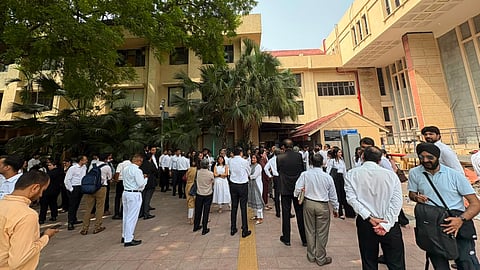

The proposed increase in the Delhi High Court’s pecuniary jurisdiction from ₹2 crore to ₹10 crore will make the Court inaccessible to many litigants and dilute its role in developing intellectual property (IP) law, leading senior lawyers have said.
Senior lawyers Chander Lall, Pravin Anand, Rajshekhar Rao, Shwetasree Majumder, Swathi Sukumar and J Sai Deepak said that the proposal should be reconsidered after consultation with litigants and lawyers.
Senior Advocate Chander Lall said that nearly 70-80 per cent of the country’s IP litigation was filed before the Delhi High Court because litigants considered it their preferred forum.
“The Delhi High Court is today about to become an elitist court,” he said.
He said that the High Court had taken nearly 35 years to develop the expertise and procedures required to routinely decide complex patent disputes. District courts, he added, presently lacked facilities such as reliable internet access, specialised registries and systems for handling online evidence and confidentiality clubs.
“WiFi in the district courts doesn’t work, so you can’t go online. Today, evidence in IP matters is done online. You can’t do that,” he said.
Lall stressed that district courts should eventually handle complex IP disputes, but opined that the transition required time, training and infrastructure.
“It can’t be a knee jerk reaction to one day increase the jurisdiction, clear your backlogs and say the job is done."
He also questioned why the underlying report, including the dissenting views, had not been placed in the public domain.
“Why is this happening in such a secretive way that we are compelled as lawyers to go on strike?"
Senior Lawyer Pravin Anand said that the proposal could send around 70 per cent of IP matters to district courts.
"Counterfeiting and trademark cases would be particularly affected because plaintiffs generally approach courts at an early stage, before substantial damages accumulate," he explained.
Anand said that the concern was not about the quality of district judges, but the absence of supporting infrastructure, registries and accessible reporting of district court judgments.
“There is no doubt about the quality of our judges. This is not a reflection on them at all...There’s not even a law report that the district courts have. Their decisions are not, right now, of the precedent-setting nature,” he added.
He highlighted that decisions of the Delhi High Court, Bombay High Court, Madras High Court and Calcutta High Court had earned international recognition. The Delhi High Court, in particular, had become a preferred forum for complex IP litigation, he said.
“The Delhi High Court is particularly the crown jewel of the country, where the reputation is so immense that publications talk about the Delhi High Court after they talk about the US and UK."
He called for dialogue between the Bench and the Bar to find an amicable solution.
Senior Advocate Rajshekhar Rao said that many significant questions of IP law arise in cases involving comparatively low monetary claims.
"Transferring such disputes would affect the Delhi High Court’s ability to continue developing jurisprudence in emerging areas."
He referred to the time taken by the High Court to decide complex disputes involving new technologies.
“We are literally now scratching at the surface of the latest aspects of technology, AI, et cetera. IP litigation, for instance, has had a few recent judgments. They have taken nearly a decade to come. If the Delhi High Court takes a decade, I am not sure the trial courts are going to be easily able to do that,” he added.
Rao suggested a staggered increase, beginning with ₹5 crore and subsequently moving to ₹7.5 crore and ₹10 crore after periodic assessments.
“Can you go from ₹2 crore to ₹10 crore at the flick of a button? Perhaps that is where we must look at a staggered movement forward."
Senior Lawyer Shwetasree Majumder said that the problem was not merely the increase in pecuniary jurisdiction, but Delhi’s uncapped ad valorem court fees. Unlike Mumbai and Kolkata, where court fees are capped, a ₹20 crore suit in Delhi could attract ₹20 lakh as court fees, she said.
Majumder added that district courts presently lacked the registry and infrastructure required for sealed filings, confidentiality clubs and other procedures involved in complex IP disputes.
“The district courts are not equipped to handle complex IP disputes as on date,” she said.
She warned that IP litigants, who often have a choice of jurisdiction, may approach other High Courts instead.
“This is the way to ensure that we drive litigation away from Delhi. That’s what’s going to happen."
Senior Advocate Swathi Sukumar described the Delhi High Court as a “global court” for IP disputes. She said that the increase was not supported by any publicly available assessment of the appreciation in the value of IP rights.
“As far as intellectual property is concerned, it is an arbitrary increase and it punishes the field,” she said.
Sukumar clarified that the issue was not one of competence or infrastructure alone.
“Structurally, the High Court is much better suited for it. It will be a tragedy if the pecuniary jurisdiction is increased in the manner that the Court has recommended."
Senior Advocate J Sai Deepak said that the wider concern was the preservation of the institutional model developed by the Delhi High Court for commercial litigation.
“It is less about shaping IP jurisprudence and more about retaining the model that the Delhi High Court has become for commercial jurisprudence."
He said that the Court’s handling of pharmaceutical patents, access to medicines and public interest questions had earned recognition across the Global South.
“The spike in the pecuniary jurisdiction tells people that only those with deeper pockets can access the better services of the Delhi High Court. That is an elitism that we can avoid,” he said.
He suggested either fixing the threshold initially at ₹5 crore or capping court fees between ₹3 lakh and ₹5 lakh, irrespective of the valuation of the suit.
He also called for the report and dissenting views to be shared with stakeholders before the opinion is forwarded to the government.
“A consensual middle path can be arrived at without compromising on the end goals that the recommendation seeks to achieve."
The Delhi High Court Bar Association (DHCBA) called the strike after holding a meeting to oppose the proposed increase in the pecuniary jurisdiction of Delhi’s district courts. The Association said that the increase would have consequences for its members and reduce cases on the High Court’s original side by 70 per cent.
The DHCBA had challenged the Full Court’s decision to constitute a judges’ committee to examine a proposal to raise the district courts’ pecuniary jurisdiction from ₹2 crore to ₹20 crore. The proposal followed a May 2025 representation by the Coordination Committee of All District Courts Bar Associations of Delhi.
Last week, the High Court allowed the committee’s report to be presented to the Full Court. It observed that while parliament alone could amend the Delhi High Court Act, 1966, the Court could examine issues concerning administration of justice and make recommendations. The Full Court reportedly approved a ₹10 crore threshold.