Supreme Court grants anticipatory bail to Congress leader Pawan Khera in Assam Police FIR

The Court observed that the allegations appeared to carry political overtones and emphasised that personal liberty cannot be lightly curtailed in cases coloured by political rivalry.
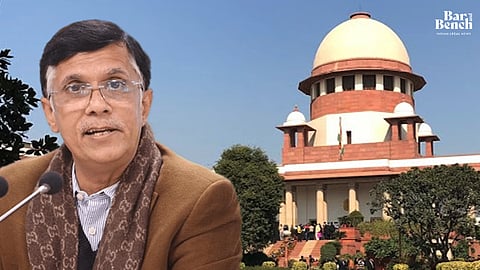
Pawan Khera and Supreme Court
Published on
3 min read
Listen to this article

The Supreme Court on April 30 granted anticipatory bail to Congress leader Pawan Khera in a defamation and forgery case registered against him by the Assam Police.
A bench of Justices JK Maheshwari and AS Chandurkar set aside the the order of the Gauhati High Court which had denied relief to Khera.

The apex court said that the circumstances of the case indicated the presence of political rivalry, warranting protection of Khera’s personal liberty.

“The allegations and counter-allegations, as apparent in the present case, prima facie, appear to be politically motivated and seemingly influenced by such rivalry, rather than disclosing a situation warranting custodial interrogation,” the Court observed.

Justice JK Maheshwari and Justice AS Chandurkar

The case alleging defamation, forgery and criminal conspiracy was registered against Khera following his recent claims at a press conference that Assam Chief Minister Himanta Biswa Sarma’s wife Riniki Bhuyan holds multiple foreign passports and undisclosed assets abroad.

Assam Police had visited Khera’s residence in Delhi on April 7 but he was not present there. 

Khera later approached the Telangana High Court seeking transit anticipatory bail.

The Telangana High Court granted him a week's relief on April 10 to enable him approach the courts in Assam for anticipatory bail.

On April 15, the Supreme Court stayed Telangana High Court's April 10 order on an appeal moved by Assam government.

Subsequently, on April 17, the top court  refused to extend the transit bail period. It asked Khera to approach the Gauhati High Court instead.

Khera then moved the Gauhati High Court.

In his petition before the Gauhati High Court, Khera argued that the allegations against him arise out of statements made in a public and political context during a press conference. He said that the same were "selectively construed" to initiate the criminal proceedings.

Khera added that the FIR was registered to "satisfy ulterior motive/political vendetta of the complainant", who is the wife of the Assam Chief Minister.

On April 24, the High Court rejected his plea.

The High Court said that custodial interrogation of Khera was necessary to find the persons who had provided him the documents he used to claim that Assam Chief Minister Himanta Biswa Sarma's wife holds three foreign passports and a company in the United States.

The High Court observed that if Khera had made the allegations only against the Chief Minister, it would have been called political rhetoric but he dragged an innocent lady into the controversy.

The High Court further said that it was not a simple case of defamation, adding that Khera was yet to prove his claims.

Khera then approached the Supreme Court against the High Court order.

Before the Supreme Court, Senior Advocate Abhishek Manu Singhvi, appearing for Khera, argued that the case rested primarily on documentary material already in possession of the authorities and that custodial interrogation was unnecessary. It was also contended that the statements were made in the course of political campaigning and did not warrant arrest.

Opposing the plea, Solicitor General Tushar Mehta, appearing for the State of Assam, argued that the documents displayed during the press conference were found to be forged and that custodial interrogation was required to trace their origin and identify persons involved in their preparation.

SG Tushar Mehta and AM Singhvi

After examining the records, the Court observed that the events in question took place during an election period and involved allegations and counter-allegations between the political figures.

It noted that statements had also been made by the CM Sarma in public forums regarding Khera, and that the material placed on record indicated a political backdrop to the dispute.

Emphasising the importance of personal liberty, the Bench underscored that deprivation of liberty must meet a higher threshold, particularly where the circumstances suggest political overtones.

“The right to personal liberty is a cherished fundamental right, and any deprivation thereof must be justified on a higher threshold, particularly where the surrounding circumstances may indicate the presence of political overtones,” the Court said.

Accordingly, it allowed the appeal and directed that Khera be released on anticipatory bail in the event of arrest, subject to conditions including cooperation with investigation, non-interference with evidence and restriction on leaving India without permission of the competent court.

The Court clarified that its observations are limited to the question of grant of anticipatory bail and would not affect the merits of the criminal proceedings, which shall be decided independently in accordance with law.

[Read Order]

Bar and Bench - Indian Legal news
www.barandbench.com